

Light exposure at night may raise risk for heart disease

Whole grains may improve several heart risk factors at once

A lumbar belt may help ease low back pain

Children of centenarians may stay healthier and live longer too, study finds

Signs of pneumonia: Sometimes vague and unexpected

The surprising link between ovarian cancer and the fallopian tubes

Using a vibration plate: What it can — and can't — do for your body

People who walk more or walk faster live longer, study finds

For sleep apnea, a dental device may be as effective as CPAP

Rosacea treatments: What works?
Breast Cancer Archive
Articles

Healthy lifestyle protects women against heart disease
It's no secret that healthy living can reduce your risk for developing heart disease. But ever wonder how much it may help? Up to 92%, suggests a study published Jan. 6, 2015, in the Journal of the American College of Cardiology. It evaluated health habits of 70,000 young and middle-aged women during a 20-year period. The habits included not smoking; exercising for at least 2.5 hours each week; watching TV for fewer than seven hours a week; consuming a diet rich in vegetables, legumes, and whole grains but low in red meat, refined grains, and sugar; consuming no more than one alcoholic drink daily; and having a body mass index in the normal range. Compared with women who had none of those habits, women with all six reduced their risk of developing heart disease by 92%. Why do those habits provide so much protection against heart disease? "Limiting TV watching frees up time for exercise, and the other activities are known to reduce blood pressure, LDL cholesterol, and blood sugar, which reduce the three major risk factors for heart disease—hypertension, high levels of cholesterol and triglycerides, and diabetes," says Dr. Randall Zusman, a cardiologist and Harvard Medical School associate professor. And even though the study involved young and middle-aged women, Dr. Zusman reminds us that it's never too late to adopt a healthy lifestyle.
Image: Thinkstock


Ask the doctor: Which supplements do I need?
Q. There seems to be agreement that supplements are worthless in supporting good health. I've been taking a multivitamin for older women for many years. I also take a calcium supplement since I am lactose intolerant. Should I discontinue the multivitamin, the calcium, or both?
A. You are definitely right about the recent consensus that most supplements, and certainly multivitamins, provide very little, if any, benefit to our health. So yes, stop taking the multivitamin. A far more important strategy to maintain good health is eating a diet containing lots of vegetables, fruit, whole grains, unsaturated fats, and small amounts of protein. Our bodies were designed to absorb nutrients from food, and that continues to be the best way to get them in our systems.

How you can drive safely at night
Changes in the aging eye may alter your night vision, but a few strategies can help you take to the road with confidence.
If you're over 50, you may be wondering if you should restrict your driving to the daylight hours. You may have read that your night vision declines at this age, or you may have noticed a little difficulty seeing in dim light. You may find glare from headlights bothersome.

Vegetarian diet linked to lower colon cancer risk
Looking for ways to ward off colorectal cancer? According to a new study, a pescovegetarian diet — that’s a vegetarian diet that includes fish — was linked to a 43% reduction in the risk of developing colorectal cancer. The study, published in JAMA Internal Medicine, adds more support to the notion that something in red meat, or the way it is cooked, encourages the growth of colorectal cancer. It’s also possible that eating more plant foods provides extra beneficial nutrients such as folate, calcium, and fiber that may protect against colorectal cancer. Fish contain healthful omega-3 fats and vitamin D. Another good strategy for preventing harm from colorectal cancer, the second leading cause of cancer death in the United States? Have colonoscopies as needed.
A woman’s testosterone-based vaginal cream linked to elevated testosterone in her husband
A woman’s use of a testosterone-based vaginal cream may have contributed to a spike in her husband’s prostate-specific antigen and testosterone levels after he had his prostate removed to fight advanced prostate cancer.

Healthy travel: Don't let this common hazard spoil your best-laid plans
Long road trips also carry a risk of deep-vein thrombosis. Take a break to stretch your legs every hour or so. Image: Thinkstock |
Long trips come with an increased risk of blood clots deep in the leg veins, which can have serious complications.
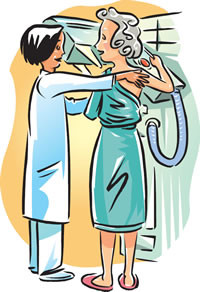
Good news about early-stage breast cancer for older women
Image: Thinkstock |
Although the chance of developing breast cancer increases after age 60, the likelihood of dying from it is low.
If you're like most women, you consider the possibility of learning you have breast cancer every time you have a mammogram. But breast cancer probably doesn't seem as scary as it did when you were younger, because there has been so much good news about breast cancer in the last 20 years—improvements in mammography, advances in surgery and reconstruction, and drugs that are more effective and less toxic.

Pelvic organ prolapse: You're not alone
Exchanging information with friends is one way to remove the stigma of pelvic organ prolapse. Image: Thinkstock |
Few women realize how common pelvic prolapse is—and how easily treated. Here are five things you should know.
Full bladder wakes women more often than thought
Two in three women over age 40 wake up at least once each night because of a full bladder, and nearly half make two or more nighttime trips to the bathroom. But only a quarter of women who get up to urinate during the night say they are bothered by having to do so.
That's the finding from a survey of more than 2,000 northern California women ages 40 and older. Factors that increased the likelihood that a woman woke at night to urinate included older age, past hysterectomy, hot flashes, and use of vaginal estrogen. However, the late-night bathroom breaks weren't caused by an overactive bladder or stress incontinence. The results were published in the January 2015 issue of the journal Obstetrics and Gynecology.
Light exposure at night may raise risk for heart disease
Whole grains may improve several heart risk factors at once
A lumbar belt may help ease low back pain
Children of centenarians may stay healthier and live longer too, study finds
Signs of pneumonia: Sometimes vague and unexpected
The surprising link between ovarian cancer and the fallopian tubes
Using a vibration plate: What it can — and can't — do for your body
People who walk more or walk faster live longer, study finds
For sleep apnea, a dental device may be as effective as CPAP
Rosacea treatments: What works?
Free Healthbeat Signup
Get the latest in health news delivered to your inbox!
Sign Up
