










Stay strong at any age with 4 basic exercises
Incorporating these lower-body exercises into daily life can help you stay active and self-sufficient as you age.
- Reviewed by Christina Ruggeri, PT, DPT, NCS, Contributor
When it comes to muscle strength, the concept of “use it or lose it” becomes even more important as you get older. If you don’t maintain your strength, your body will work against you as your muscle mass naturally declines over time.
People who build and maintain strength, especially in their lower body, maintain better balance and ability to function in their daily lives as they age. They may also live longer. A study of nearly 5,500 women published in the February 2026 issue of JAMA Network Open found that those over age 65 with greater leg strength had a lower risk of dying during the following eight years.
Christina Ruggeri, a physical therapist with Harvard-affiliated Spaulding Rehabilitation, offers some advice to improve your physical condition so you can stay active and independent for years to come.
Get moving
One of the most important habits to adopt is to do at least 30 minutes of moderate-intensity aerobic activity on at least five days a week.
“Some people have the misconception that daily tasks like doing laundry and grocery shopping count as moderate-intensity activity,” says Ruggeri. But you need to do more. “After you put the clothes in the washer, walk up and down the stairs a few times, and when you go to the grocery store, walk up and down all the aisles before you start shopping,” she says.
In addition to moving more, you also need to sit less and stand up occasionally. “Your body wants to be in motion,” says Ruggeri. When you’re sitting for prolonged periods, get up every 30 to 45 minutes, even if you just stand up and sit back down again. “This will decompress your lower back and help with blood circulation,” she says.
In addition, to counteract the loss of muscle power from aging — and prolonged sitting — incorporate the following four leg-strengthening exercises into your daily routine.
1. Sit-to-stands
Sit-to-stands train the muscles you need to get up from a chair, in and out of a car, and off the toilet.
To perform a sit-to-stand, start by standing in front of a chair. Cross your arms over your chest. Squat down as if you’re going to sit in the chair. Instead of sitting, tap the chair with your buttocks and stand back up. If this is too difficult, place a pillow on the chair and tap the pillow. Once you can do this without difficulty, remove the pillow.
Sit-to-stands are a good way to start building strength. “But you have to maintain it,” says Ruggeri. On most days of the week, perform two sets of 10 sit-to-stands — that is, do the exercise 10 times in a row, rest for a minute or two, then do 10 more. Once it becomes easy, you can increase the difficulty by holding the squat position for three to five seconds before standing up.
2. Glute sets
You also need to keep your gluteal muscles (glutes) strong. “These three muscles in the buttocks are powerhouses for stabilizing the body,” says Ruggeri. They help you stand, walk, run, and climb stairs. They keep your pelvis and hips stable. When you sit a lot, however, these muscles weaken.
“An exercise called a glute set strengthens these muscles,” says Ruggeri. You can do it sitting, standing, or lying down. Simply squeeze the muscles in your buttocks together and hold, then relax.
You don’t have to set aside dedicated time to do this. “When you’re in a car and come to a red light, pull your buttocks together, get a nice contraction, and hold it until the light turns green,” says Ruggeri. Or do it during commercial breaks when you’re watching TV.
Most red lights last for 30 to 90 seconds. If you can’t hold the contraction for that long, keep trying. “We all have to sit at red lights; you might as well do a little workout,” she says.
Once you’ve mastered it, try contracting just your right buttock and then just your left one, to work the muscles on each side independently.
3. Heel raises
The heel raise exercise has several benefits. It strengthens muscles and improves range of motion in the ankle and works the calf muscles. It also improves blood circulation. When the calves contract during a heel raise, they squeeze the deep veins in the lower leg and help push blood back up toward the heart.
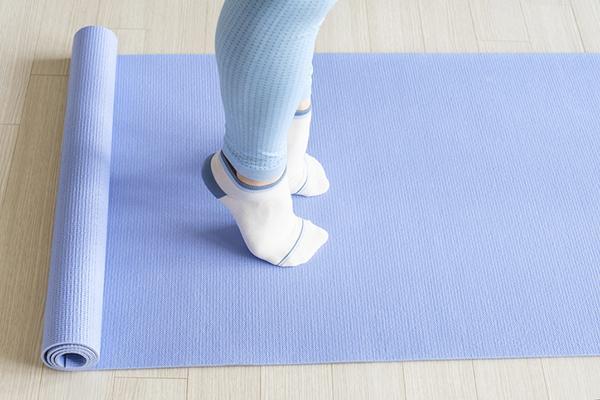
To do a heel raise, stand and lift both heels up so that you’re balancing on the balls of your feet, then come back down. Do two sets of 10 at least every other day. To make it more challenging, stay up on the balls of your feet for three to five seconds each time.
4. Single-leg stand
“It’s also incredibly important to work on balance,” says Ruggeri. “You should be able to stand on one foot with your eyes open for 30 seconds.” When you think of daily living, you often need to balance on one leg. If you can’t hold yourself for a few seconds on one leg, it becomes more difficult to walk, go up and down stairs, step into a tub, or get into a car.
Single-leg stands help with balance and also strengthening, because one leg needs to support all of your body weight.
Stand with your feet hip-width apart. Lightly hold a sturdy surface if you need. Lift one foot a few inches off the floor. Hold, then lower your foot, and repeat with the other leg. Work up to holding for 30 seconds at a time.
Test your baseline strength
Here’s a simple test of leg strength: Sit in a chair with your back against the chair and your arms folded across your chest. Have someone time you while you stand up and sit back down five times in a row, as quickly as you can. Other than when you start, try not to let your back touch the chair back when you sit. Based on your age, you should be able to stand up and sit back down five times within the time indicated below.
For more information, check out the Harvard Special Health Report Mobility and Independence. |
Image: © Tatiana/Getty Images
About the Author

Lynne Christensen, Staff Writer
About the Reviewer

Christina Ruggeri, PT, DPT, NCS, Contributor
Disclaimer:
As a service to our readers, Harvard Health Publishing provides access to our library of archived content. Please note the date of last review or update on all articles.
No content on this site, regardless of date, should ever be used as a substitute for direct medical advice from your doctor or other qualified clinician.


