










Scoliosis treatment: Can it help as you get older?
Exercises aim to compensate for the muscle imbalance caused by adult scoliosis.
- Reviewed by Nancy Capparelli, PT, MSPT, OCS, Contributor
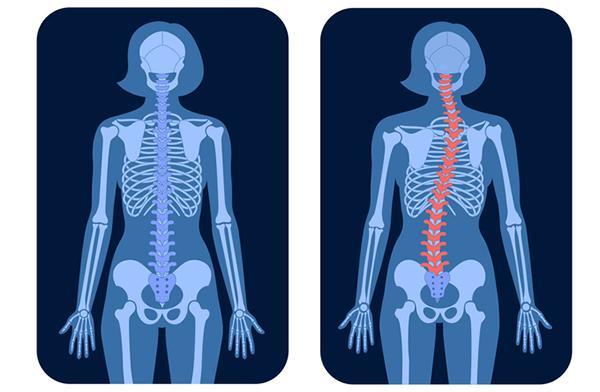
When you hear the word scoliosis, you may think of a condition that affects children and adolescents. While this is true, the condition — a sideways curve in the spine — is even more common among older adults. Many adults with scoliosis have no symptoms, and they may not know they have it. For others, the spinal deformity causes pain, difficulty walking, and other problems. In severe cases, it can be corrected with surgery; however, this is usually not necessary. Physical therapy for scoliosis is generally all that’s needed.
What is scoliosis?
“With scoliosis, there’s a sideways C- or S-shaped curve in the spine,” says Nancy Capparelli, a physical therapist with Harvard-affiliated Beth Israel Lahey Health. In adults, the curve can be a continuation and possibly a worsening of childhood scoliosis. It can also develop later in life from wear and tear on the spine.
Over time, everyone experiences some degree of disc degeneration, a wearing down of the shock-absorbing discs between the vertebrae in the spine. The discs lose height, becoming thinner. In some people, the discs collapse more on one side than the other, making the spine curve.
Some people with scoliosis lean noticeably to one side or have difficulty standing fully upright. One shoulder or hip may be higher than the other one.
How does it affect the body?
People with scoliosis may have back pain due to muscle imbalance from the shift in body alignment. If you’re bent over to the right, the muscles on the right side shorten and become compressed, and the muscles on the left lengthen. “Muscles that are stretched for too long don’t work effectively,” says Capparelli. If the curve compresses a nerve in the spine, you may feel numbness or tingling in one or both legs.
Scoliosis can also restrict the range of motion of the spine. “If the curve is in the upper part of your mid-back, it can limit your ability to rotate your trunk and move your shoulders and neck,” says Capparelli. A curve in the lower back can cause problems there and in the hips.
Body misalignment can cause one leg to be shorter than the other, which may contribute to back pain. It can also lead to pain in the knee, hip, or ankle on the longer side, which is under more pressure. A discrepancy of more than half an inch between the two legs can be corrected with a heel lift in the shoe.
Which exercises are helpful?
If you have symptoms, your doctor might recommend physical therapy that focuses on easing pain and maintaining function. “It’s about trying to compensate for the imbalance,” says Capparelli.
Some scoliosis exercises aim to shorten the lengthened side and stretch the shortened side. For example, try this exercise, a variation of the yoga posture known as child’s pose that adds a diagonal stretch: Kneel on all fours, with your knees apart, big toes touching, and your head and neck in line with your spine. Drop your buttocks back toward your heels, letting your hands extend in front of you, and rest your forehead on the mat. If your right side is the shorter side, walk your hands diagonally to the left and back again.
Capparelli also recommends exercises to strengthen core muscles, improve the stability of the torso, and maintain good posture. For core strengthening, try planks, which you can modify based on your ability. The bird dog (also called opposite arm and leg lift) focuses on both core strength and control (see “Bird dog”).
In addition, Capparelli teaches people how to perform exercises using a stability ball (an inflatable ball that comes in different sizes). “The ball is an unstable surface, so you inherently work your trunk muscles a bit harder,” she says.
The specific exercises that are right for you depend on factors such as the degree of the curve and the symptoms you’re experiencing. A physical therapist can evaluate you, make specific recommendations, and show you the correct form for exercises.
Bird dog
Kneel on all fours with your hands and knees directly aligned under your shoulders and hips. Raise your left leg and extend it straight behind you while you stretch your right arm out in front of you, so the arm and leg are parallel to the floor. Hold briefly, then return to the starting position. Then repeat, lifting the right leg and left arm. Keep your abdominal muscles tight and your hips level. Do three sets of 10 repetitions. Photo by Thomas MacDonald |
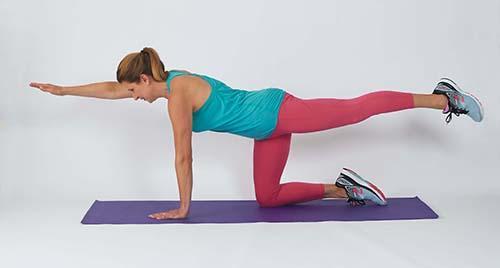
Image: © Pikovit44/Getty Images
About the Author

Lynne Christensen, Staff Writer
About the Reviewer

Nancy Capparelli, PT, MSPT, OCS, Contributor
Disclaimer:
As a service to our readers, Harvard Health Publishing provides access to our library of archived content. Please note the date of last review or update on all articles.
No content on this site, regardless of date, should ever be used as a substitute for direct medical advice from your doctor or other qualified clinician.


