










Poison ivy rash: Symptoms, treatment, and prevention
Its intense itchiness and blisters can make you miserable, but knowing what causes a poison ivy rash can help you treat it promptly and avoid it in the future.
- Reviewed by Rebecca Gaffney, MD, Editorial Advisory Board Member, Harvard Health Publishing
|
Summary Poison ivy rash is a red, blistering, itchy skin reaction caused by contact with the oily resin of the poison ivy plant. Quickly washing any exposed skin and contaminated clothing, tools, pets, or gear may help reduce the risk of a reaction. For a mild rash, home remedies and over-the-counter medications can help soothe symptoms; stronger prescription drugs can help heal more severe cases. |
Poison ivy rash is an allergic skin reaction to urushiol, a very sticky, oily resin produced by poison ivy and certain other plants. When it comes from poison ivy, the resin often triggers classic poison ivy symptoms: itching, redness, swelling, and blisters. To avoid the discomfort, it helps to learn how to recognize and treat poison ivy rash, and how best to prevent run-ins with this toxic plant in the first place.
What is poison ivy?
Poison ivy is a common poisonous plant that grows in every US state except Hawaii and Alaska. People typically encounter it in late spring and summer “because they’re outside more, doing things like cleaning out their yards, gardening, and hiking,” says Dr. Rebecca Gaffney, a clinical instructor in dermatology at Harvard Medical School.
But the plant can cause contact dermatitis year-round because the resin that produces the poison ivy rash is found not just in the leaves you’re more likely to encounter in the spring, summer, and fall, but also in the stems, vines, roots, flowers, and berries. Plus, some evidence has suggested that poison ivy may become more toxic — growing larger and producing more reaction-inducing urushiol — in response to elevated levels of carbon dioxide associated with climate change.
What does poison ivy look like? One telltale sign: its three-leaf clusters, each growing out of a single stem. (You may be familiar with the rhyming warning “leaves of three, let them be.”)
|
Poison ivy grows in three-leaf clusters. It can spread as a vine or grow as a shrub. Image: © Denise Panyik-Dale/Getty Images |
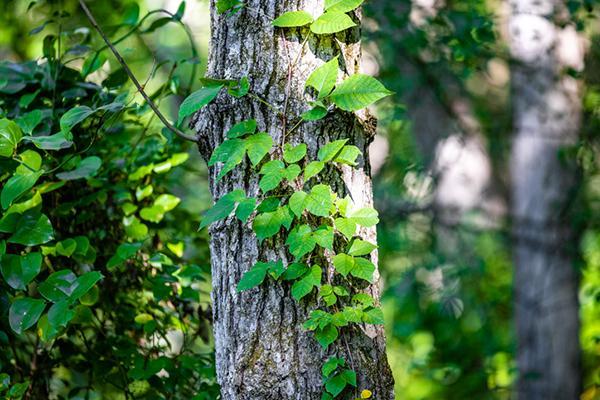
But it’s also important to know how to recognize poison ivy in its various seasonal guises to help avoid unwittingly coming in contact with the plant when it doesn’t have its classic appearance (see “Frequently asked questions”).
Poison ivy symptoms and rash stages
Most people who come in contact with urushiol develop an allergic skin response, with the severity determined by the amount of resin they’re exposed to. If you’ve encountered poison ivy before, the rash usually appears within 24 to 48 hours. But it can take up to three weeks to develop if you have not been previously exposed. The time gap between exposure and the appearance of a reaction “is why a lot of people mistakenly think, 'Oh, this isn’t poison ivy because it didn’t show up until a week later,’” Dr. Gaffney says.
“Some people have a really strong reaction, and for others it’s very minimal,” Dr. Gaffney says. “But it can change over time. With repeated exposure, you can develop a stronger reaction,” she notes — even if you’ve never had an issue with poison ivy before.
There are three poison ivy rash stages:
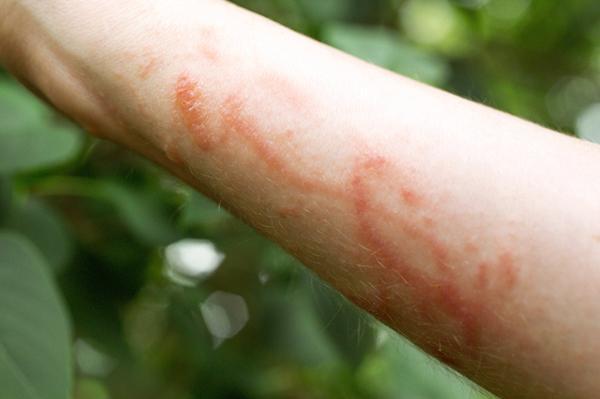
A little itching and redness. The skin touched by the resin starts to itch, and streaks or areas of redness (brown or violet in darker skin) may appear.
Swelling and blisters. A day or two after the itching and redness start, inflammation increases, causing more redness and swelling, and often fluid-filled poison ivy blisters. Blisters can develop over the course of a week or longer and may burst open and ooze clear fluid, becoming intensely itchy.
Crusting over. The blisters start to dry up and crust over before they fade away.
It can take one to three weeks for a case of poison ivy to completely go away.
Poison ivy treatment
Knowing how to treat poison ivy can help reduce the itch and clear up a mild, limited rash. Dr. Gaffney says the following treatments can help:
Topical hydrocortisone 1% creams. These are available over the counter and may help soothe the inflammation.
Antihistamines. Although poison ivy rash is a hypersensitivity reaction that doesn’t involve histamine, if itchiness keeps you up at night, an antihistamine like diphenhydramine (Benadryl) that makes you drowsy may help you sleep, Dr. Gaffney says. For daytime itch, she recommends a non-sedating antihistamine such as fexofenadine (Allegra) or cetirizine (Zyrtec).
Oatmeal baths. This home remedy for poison ivy can help quell its itching and irritation. Add finely ground oatmeal (also called colloidal oatmeal) to a tub of lukewarm water and soak for 15 minutes. You can buy packets of an oatmeal bath product or grind one cup of uncooked oatmeal in a blender or food processor to use for one bath.
Cool compresses. Douse a washcloth in cold water, wring it out, and apply it to your rash for 15 to 30 minutes several times a day to help relieve itch and irritation.
Calamine or menthol anti-itch lotions. These may be soothing and Calamine lotion may also help dry out blisters.
Whatever remedies you use, try to refrain from scratching the rash, since bacteria that live under your fingernails may cause a skin infection that will likely require medical attention.
When to see a doctor for a poison ivy rash
Seek medical help for a bout of poison ivy if a rash
- is extensive
- involves the face, eyes, or genitals
- causes significant swelling
- interferes with your sleep or daily activities
- shows signs of infection, such as fever or pain, spreading redness, or blisters that ooze pus instead of clear fluid.
Your primary care doctor or a dermatologist can prescribe a higher potency topical steroid or an oral steroid to bring the inflammatory symptoms under control. If you have an infection, you may be prescribed an antibiotic to clear it up.
Most cases of poison ivy can be handled on an outpatient basis. But if you inhale smoke from a fire where poison ivy is being burned and you develop difficulty breathing, wheezing, and throat tightening, head to a hospital emergency room (ER). The reason: the toxic resin can become airborne and inflame the lining of the lungs if you breathe it in. Dr. Gaffney also recommends going to an ER if your eyes are swollen shut or if there’s significant swelling around your face and neck.
However, if you do see a health care provider for a bad case of poison ivy, be aware that the course of steroids you receive may not be long enough to heal your rash. A 2022 study published in the Western Journal of Emergency Medicine found that many doctors gave patients shorter-duration prescriptions despite recommendations to treat severe poison ivy with oral steroids for at least 14 days. The risk of shorter treatment is rebound dermatitis, a return of the poison ivy rash that can be quite severe, Dr. Gaffney says. In the study, patients treated with the shorter prescriptions were 30% more likely to require additional visits to a health care provider than those given a prescription for 14 to 20 days.
How to prevent poison ivy exposure and future rashes
Poison ivy prevention calls for precautions to avoid the plants and their oily resin. The resin transfers with surprising ease from clothing, pet fur, and even a brief brush against a leaf. Take these steps to protect yourself:
Learn to recognize poison ivy. Become familiar with its appearance during each season of the year. When hiking, stay on trails or paths; when camping, pitch your tent in a spot that’s free of poison ivy.
Protect your skin outdoors. Wear long-sleeved tops, pants, socks, and boots. If you’re gardening, wear gloves.
Consider a barrier cream. Use a nonprescription product (an “ivy block” such as Ivy X) that you can apply to parts of your body most likely to come in contact with urushiol. It’s meant to be applied 15 minutes before you go into an area with poison ivy.
Put your pets on a leash. This will help prevent pets from running off and getting urushiol on their fur. (Pets are rarely bothered by urushiol, but they can transfer it to their humans.)
Thoroughly wash off the oily resin. After you’ve been outdoors in an area where poison ivy may be growing, put on disposable gloves and carefully put your clothing (including hat and gloves) into a washing machine as soon as you can. With gloves on, clean your shoes and tools with alcohol wipes, and bathe pets whose coats may be contaminated. Take a warm shower, using a mild soap to clean yourself; rinse well. Be sure to scrub under your nails. Afterward, apply a scent-free moisturizer to keep your skin hydrated. (Dry skin can make you feel itchy.)
Rid your yard or garden of poison ivy. Don heavy gloves and pull the plants up from the ground or kill them with an herbicide. Never burn poison ivy, since doing so can cause urushiol to be carried into the air via the smoke.
Frequently asked questions
What does poison ivy look like?
Poison ivy can look very different, depending on the season and the area of the country where you live. It may be
- a climbing, ropelike vine with hairy tentacles that help it attach to a tree or fence
- a low-growing shrub (especially in the western United States)
- a creeping vine that spreads out, carpeting the ground.
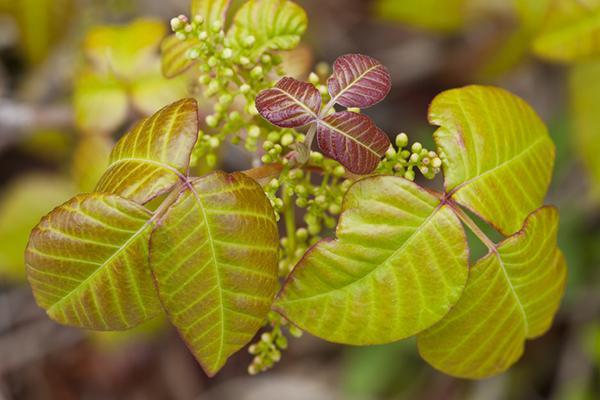
In spring and summer, poison ivy leaves may be a lustrous green or red, with white flowers that eventually yield cream-colored berries.
|
Poison ivy leaves are often green in summer, with white flowers or cream-colored berries. Each part of the plant harbors the resin that produces the poison ivy rash. Image: © Ed Reschke/Getty Images |
In autumn, the leaves may turn yellow, orange, or red. During the winter, poison ivy may be a leafless vine or shrub.
|
Image: © Rex Lisman/Getty Images |
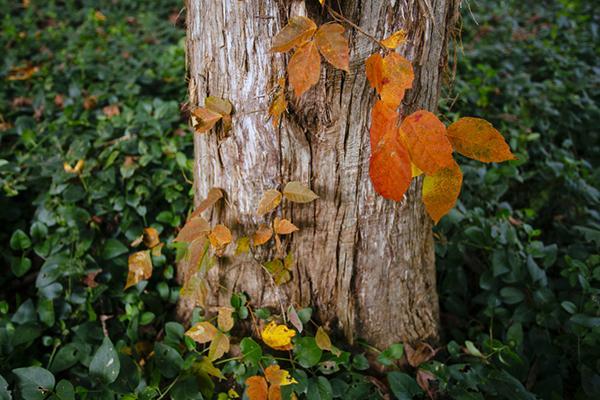 Poison ivy carries toxic resin throughout the year, even as the plant turns yellow, orange, red, or brown in the fall and winter.
What does a poison ivy rash look like?
Signs of poison ivy rash include red, swollen areas or streaks and, often, fluid-filled blisters. In rare cases, tiny black spots will develop instead of the more typical red rash. On dark skin, the rash is more likely to show up as dark brown, violet, or grayish bumps.
After poison ivy’s healing stages are complete, your skin may be darker or lighter where you had the rash because inflammation can affect the amount of pigment produced by the cells. Darker-skinned individuals who are left with an area of deeper pigmentation should use sunscreen and avoid sun exposure, Dr. Gaffney advises, to avoid further discoloration.
Is poison ivy contagious?
No, poison ivy is not contagious. It’s a common misconception that weeping blisters can spread poison ivy to other parts of your body or to other people. If you develop new spots, it’s because they were exposed at a different time to the sticky poison ivy resin. This could happen if you touch contaminated clothing or gear or because someone else has the resin on their skin or clothing and you come in contact with it.
If you don’t clean items (such as camping gear or gardening tools) that have been contaminated, touching them can put your skin in contact with the resin again — which can lead to a new poison ivy rash, even years later. That’s why it’s important to clean everything thoroughly after exposure.
How long does poison ivy last?
Typically, a bout of poison ivy lasts for one to three weeks. If you have had the rash in the past, a new one may last up to 14 days; if this is your first time, it can drag on for 21 days. If you are exposed again to the resin and develop poison ivy rashes elsewhere on your skin, the entire episode may last longer.
Image: © Jena Ardell/Getty Images
About the Author

Jennifer Cook, Health Writer
About the Reviewer

Rebecca Gaffney, MD, Editorial Advisory Board Member, Harvard Health Publishing
Disclaimer:
As a service to our readers, Harvard Health Publishing provides access to our library of archived content. Please note the date of last review or update on all articles.
No content on this site, regardless of date, should ever be used as a substitute for direct medical advice from your doctor or other qualified clinician.


