Hearing aids: Types, costs, over-the-counter options, and AirPods
Learn what's available and what may work best for you.
- Reviewed by Meaghan Reed, AuD, CCC-A, Contributor
|
Summary Hearing aids amplify sound and can improve communication for most people with hearing loss. They come in several styles and offer different features, so you can choose an option that fits your preferences, technology comfort level, and degree of hearing loss. Hearing aids are available by prescription or over the counter; over‑the‑counter options include certain types of earbuds. |
If you’re struggling with hearing loss, a hearing aid can help you stay better connected with the world around you. But choosing one can sometimes feel overwhelming.
“Any individual who is experiencing communication or hearing difficulty, or who is having trouble hearing in noisy environments, could consider a hearing aid,” says Meaghan Reed, director of clinical audiology at Harvard-affiliated Massachusetts Eye and Ear.
The road to clearer hearing starts with understanding which options may be right for you. Here’s what you need to know about how these devices work, if it’s worth considering an over-the-counter hearing aid, and even whether you can use your AirPods to help you hear better.
What are hearing aids and how do they work?
Hearing aids are small, battery-powered medical devices that can be worn in or around your ear. They help people with common types of hearing loss by making sounds louder. Hearing aids don’t restore your natural hearing, but they can make it easier for you hear more clearly.
Hearing aids have a microphone that picks up sound in your environment. The microphone then converts the sound into electrical signals. These signals are processed by a computer chip and made louder. Then they’re sent into the ear through a tiny speaker.
Most hearing aids are digital and many can be synched with your smartphone. With this connection, you can use your phone to adjust the volume or reduce background noise in your hearing aids. You can also stream music, phone calls, and podcasts directly from your phone to your hearing aids.
Some models use disposable batteries, but most use rechargeable ones. Hearing aids with rechargeable batteries can be charged like a smartphone.
Some hearing aids can be programmed to give you a specific volume based on your level of hearing loss. Many models also have enhanced features. These include remote controls, technology to help you hear better in noisy environments, or the ability to program certain settings in advance.
Prescription vs. over-the-counter hearing aids: What's the difference?
Some hearing aids are available by prescription. Others can be bought over the counter (OTC).
Prescription hearing aids are meant for people with common types of hearing loss who may benefit from sound amplification. In order to get one, you need to have a hearing exam with a hearing healthcare professional (HHP). The HHP will also make sure your hearing aid is fitted correctly and programmed to meet your hearing needs.
OTC hearing aids are meant for adults 18 and older with mild to moderate perceived hearing loss. Because they’re designed for milder hearing loss, they tend to have fewer features and less volume strength.
OTC hearing aids are different than personal sound amplification products (PSAPs), which are nonmedical devices made for people with normal hearing. They are not recommended for people with impaired hearing; instead, they may be helpful to amplify sounds in recreational settings, such as birdwatching.
OTC hearing aids are available for purchase online and in major retail stores. You may also buy one from an HHP. The HHP can perform a hearing test and a hearing aid evaluation and recommend specific products to meet your needs.
How to choose hearing aids
There are different factors to consider when choosing between OTC and prescription hearing aids. “In some ways it really depends on the individual,” Reed says. Here are some factors to consider:
Level of hearing loss. Research shows that OTC hearing aids can be helpful for people with mild to moderate hearing loss. But prescription models tend to be a better bet for people whose hearing loss is more severe. That’s because they can be more powerful.
Budget. OTC options are generally less expensive than prescription ones. Prescription and OTC models may be covered by some private insurers. Hearing aids are not covered by standard Medicare plans but are often covered by Medicare Advantage and Medicaid plans; check your policy for details.
Comfort with technology. OTC hearing aids are typically set up and programmed at home by you. Prescription devices are programmed by an HHP during your doctor’s visit.
Both OTC and prescription hearing aids are regulated by the FDA. If you choose to buy over-the-counter hearing aids, look for the words “OTC” and “hearing aid” on the packaging. Avoid products that don’t list these words. They may be PSAPs masquerading as OTC hearing aids.
What types of hearing aids are available?
Hearing aids come in a range of styles. The type you select depends on your level of hearing loss and your personal preferences. Here are common options.
Completely-in-the-canal (CIC) devices are the smallest, least visible type of hearing aid. They sit entirely in the ear canal. They’re used for mild to moderate hearing loss.
In-the-canal (ITC) devices fit partly in the ear canal but are still less visible than other types of hearing aids. They’re generally suitable for hearing loss up to the mild-to-moderate range.
In-the-ear (ITE) devices are larger and sit inside the outer ear. They have more features that are better suited to moderate to severe hearing loss.
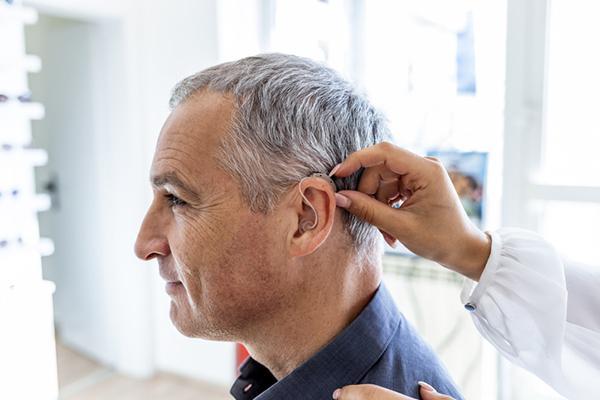
Behind the ear (BTE) devices hook over the top of the ear and can be appropriate for people with a wide range of hearing loss. Because they can provide more amplification than many smaller devices, they are often a good option for people with severe hearing loss.
Receiver-in-the-ear (RTE) devices are one of the most common and flexible hearing aid styles. They hook over the top of the ear. They also have a receiver that sits in the ear canal. RTEs offer a wide range of features and amplification options for people with many different degrees of hearing loss.
Earbuds (such as the Apple AirPods Pro 2 and Pro 3) fit in the ear, and are large and quite visible. While not technically hearing aids, these earbuds have hearing aid functions (more on these below).
Talk with your doctor or an HHP if you’re unsure which type of hearing aid is best. Together, you can assess your hearing to decide on the right option for you.
How much do hearing aids cost?
Hearing aid costs vary widely, from hundreds of dollars per pair to $7,000 or more. Prescription devices may cost more than OTC options because the price often includes services provided by an HHP. That can include an evaluation, fitting, programming, and follow-up care. Cost may also vary based on a device’s technology and features.
Can AirPods or other earbuds work as hearing aids?
Currently, Apple’s AirPods Pro 2 and AirPods Pro 3 are the only earbuds with an FDA- authorized hearing aid software device that lets them function as OTC hearing aids. They also include features that may help some people hear better in noisy environments. “If you’re having trouble hearing and already own AirPods Pro 2 or 3, you can activate the hearing aid feature to see whether it helps help you hear better,” Reed says.
Who should consider hearing aids?
Anyone with hearing loss that can be improved with sound amplification may benefit from a hearing aid. You may have some degree of hearing loss if you
- have trouble following or understanding conversations
- often ask people to repeat things
- tune out of conversations because you can’t hear them.
If you suspect that you have hearing loss, talk with your doctor or an HHP. They can conduct a hearing exam and help you decide if a hearing aid is a good choice for you.
Frequently asked questions
Are over-the-counter hearing aids as good as prescription devices?
OTC hearing aids can do a good job of helping people with mild to moderate hearing loss. But they require a little more work to use, since you need to set them up yourself. OTC hearing aids are not powerful enough for people with severe hearing loss.
How long do hearing aids typically last?
Hearing aids usually have a lifespan of three to seven years, depending on the type of device you choose. Some may last longer. Some signs that your hearing aid may need to be replaced or repaired include
- suddenly hearing static
- suddenly not being able to hear as well
- batteries losing their charge faster.
Image: © ljubaphoto/Getty Images
About the Author

Marygrace Taylor, Health Writer
About the Reviewer

Meaghan Reed, AuD, CCC-A, Contributor
Disclaimer:
As a service to our readers, Harvard Health Publishing provides access to our library of archived content. Please note the date of last review or update on all articles.
No content on this site, regardless of date, should ever be used as a substitute for direct medical advice from your doctor or other qualified clinician.