










Got hand pain? Try these kitchen hacks
With a few strategies and gadgets, you can prepare meals without it hurting your hands.
- Reviewed by Deborah Simmons, OT, Contributor
Tired of always asking someone to open jars for you? Does chopping and slicing vegetables hurt your hands so much that you've stopped doing it? Are you cooking less because of pain, stiffness, or deformities in your fingers, thumbs, or wrists?
You don't have to give up cooking or other kitchen tasks. Most limitations caused by hand pain can be overcome using simple strategies and helpful gadgets.
"A lot of it has to do with joint protection and ergonomics," says Deborah Simmons, an occupational therapist with Harvard-affiliated Spaulding Rehabilitation. Ergonomics includes the use of tools designed to be comfortable, safe, and easy to operate.
Tips for protecting your joints
Before you start shopping for new kitchen gadgets, Simmons has some suggestions that don't cost anything.
- Rearrange your kitchen setup. Move items that you use regularly within easy reach, putting them on the counter or in an easily accessible cabinet. "The stuff you use every day, especially heavier items, should be kept at waist height," says Simmons. "The dish you only take out for a holiday dinner can go in the cabinet above the fridge."
- Whenever possible, use your larger, stronger joints. For example, when stirring something in a bowl, use your whole arm instead of the smaller joints like the fingers and wrists.
- If you can, use two hands instead of one for a task.
- Don't carry grocery bags (or any bags) by grasping the handles with your hands. Place the handles in the crook of your elbow, or even better, over your shoulder.
- Carry large items, especially heavy ones, close to your body and with two hands if possible.
- Soak dishes before washing them.
- If you use a splint or brace to help stabilize a joint, use it when working in the kitchen.
Simmons emphasizes that you don't have to do everything yourself. "Delegate when you can," she says. Ask your partner to do the heavier tasks while you take care of things that don't exacerbate your symptoms.
She also recommends conserving energy. Take breaks, and keep a chair nearby. "You don't want to use up energy standing for too long, because you may not have enough energy left to finish making the meal," she says. "Taking breaks throughout an activity will help you be more productive and effective, even if it takes a little more time to do it."
Take advantage of gadgets
Consider purchasing specialized utensils, gadgets, and appliances or adapt the ones you already have. "There are plenty of tools to help protect joints and allow you to function without irritating your symptoms," says Simmons (see "Handy gadgets").
One of the most difficult actions for people with painful hands is to hold something with a slender handle. There's a simple solution - wider, easier-to-grip handles. Wide-handled options for cooking and eating utensils and other kitchen tools are available and often inexpensive. You can also purchase foam products that slip onto handles to widen them.
A nonslip, grippy product like Dycem, which comes in rolls, has many uses. Wrap it around handles to build them up, or place a piece under a bowl or cutting board to stabilize it.
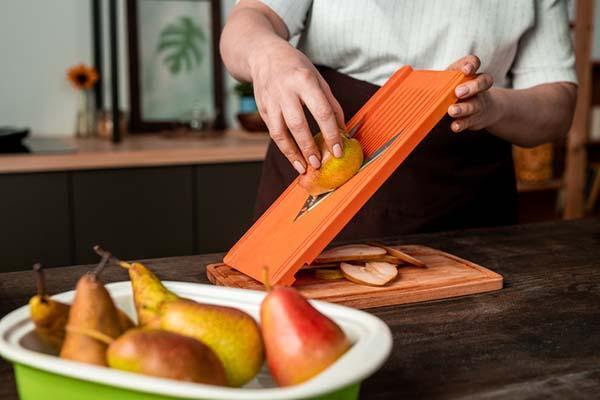
Repetitive movements, such as chopping and slicing, can irritate painful hands. Instead of using a knife, put veggies into a food processor, or use a push-button chopper or a mandolin (a handheld tool with a sharp blade that slices vegetables into thin pieces). Using a mandolin does require using your hands, "but you're using a bigger joint to slice the food," says Simmons.
Get help
If you need additional help, consult an occupational therapist who can work with you to solve the particular problems you're having, whether in the kitchen or in other aspects of daily life. An occupational therapist will evaluate you and make recommendations tailored to your needs.
Handy gadgetsHere are a few useful tools to make kitchen duties easier:
|
Image: © Pressmaster/Getty Images
About the Author

Lynne Christensen, Staff Writer
About the Reviewer

Deborah Simmons, OT, Contributor
Disclaimer:
As a service to our readers, Harvard Health Publishing provides access to our library of archived content. Please note the date of last review or update on all articles.
No content on this site, regardless of date, should ever be used as a substitute for direct medical advice from your doctor or other qualified clinician.


