










Get a grip: How to manage thumb arthritis
No longer able to open a jar without thumb pain? Arthritis may be to blame.
- Reviewed by Christine Caiati, MS, OTR, OT/L, CHT, Contributor
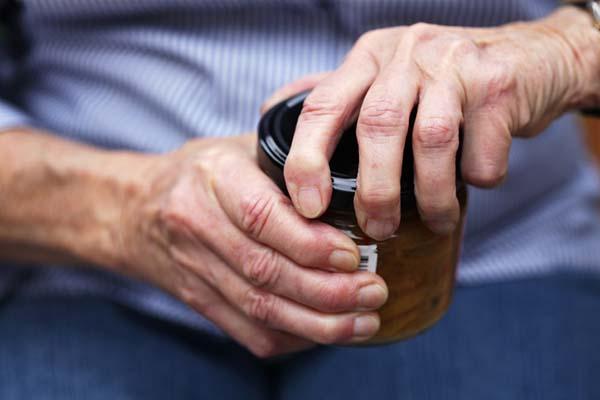
Our thumbs are a marvel, allowing us to effortlessly grip and grasp items. In fact, about 40% of hand function relies on the thumb. "When anything happens to our thumbs, it can really impair our ability to function," says Christine Caiati, a certified hand therapist and occupational therapist with Harvard-affiliated Spaulding Rehabilitation.
If simple tasks such as opening a jar, holding a plate, or pulling up your slacks become difficult and painful, it's possible that the problem is thumb arthritis. After age 70, women are about twice as likely to develop this type of arthritis as men.
What is thumb arthritis?
The thumb joint most likely to develop osteoarthritis is called the carpometacarpal (CMC) joint. It's at the base of the thumb, between the long bone in the meaty part of the thumb and a small bone in the wrist called the trapezium.
The CMC joint provides the thumb a large range of motion, including the ability to be opposable. This means it can move so it touches the tips of the other fingers, allowing the hand to hold and manipulate items. Ligaments (flexible bands of tissue that connect bones to other bones), tendons, and muscles provide stability.
Arthritis in this joint, called basal thumb arthritis, is a problem of both degeneration and instability. As with osteoarthritis in any joint, the cushioning cartilage that covers the ends of the bones wears down (degenerates). The supporting ligaments loosen, leading to instability.
"When this happens, the bones may no longer line up properly to function in a way that's effective and not painful," says Caiati.
Common symptoms of thumb arthritis
Symptoms of thumb arthritis include new or worsening pain at the base of the thumb, and pain that extends into the hand or wrist on the thumb side. It can hurt when you pinch, twist, or grab. A lateral pinch (bringing the thumb toward the side of the index finger) can be particularly painful. It can also hurt when you're not moving it.
Some people are prone to dropping things because of pain, weak muscles, or a misaligned joint that doesn't send the right information to the brain about which muscles to engage to keep your hand around something.
Over time, the hand and thumb may develop visible changes that can affect range of motion:
- The base of the thumb may bulge outward, creating what's called a shoulder sign.
- The space between the thumb and index finger may shrink, turning a wide V shape into a narrow angle.
- In severe cases, the thumb can take on a zigzag shape, known as a Z deformity.
How doctors diagnose thumb arthritis
To get a diagnosis, Caiati recommends seeing a hand surgeon. A primary care doctor or rheumatologist can also make the diagnosis. There's no single thumb arthritis test. Instead, the diagnosis can be made with a physical examination and x-rays. The x-ray technician will place your hand in different positions for the x-rays to determine the amount of degeneration and degree of deformity.
The doctor may refer you to an occupational therapist specializing in hand therapy or - for a more severe case - may recommend surgery.
Treatment options for managing thumb arthritis
If arthritis is not too severe and you use joint protection techniques, there's a good chance you'll never need surgery. "We teach people how to use the thumb in ways that favor hand positions that provide stability and discourage ones that can cause instability," says Caiati. Therapy typically includes these elements:
Training in better mechanics. For instance, you'll learn to avoid pinching with the thumb against the side of the index finger, which places stress on the joint. Keeping the hand in a rounded C shape while grasping and releasing items is gentler and more stable.
Hand therapy. Occupational therapists teach exercises to strengthen the small muscles that support the joint. These movements are targeted to stabilize (not strain) the thumb. Here's a simple example: Pretend you are holding a tennis ball in your hand. Squeeze gently and hold. Repeat 10 to 20 times. This can help train the hand to keep the thumb in a stable position.
Splints and taping. There are both soft and rigid splints, along with special taping techniques. These can help stabilize the thumb and train the hand to use the most stable positions. You can get a custom-made splint or buy one over the counter; ask your occupational therapist for a recommendation to ensure you get the right kind. A hand splint intended for carpal tunnel syndrome will place the thumb in the wrong position for thumb arthritis.
Pain relief. Heat and self-massage may help to relieve pain. Warmth tends to soothe aching joints more effectively than ice. Consult your doctor about the most appropriate pain medication. Many doctors will offer a corticosteroid injection for pain relief.
If pain continues to interfere with daily life despite these measures, your doctor might recommend surgery.
Image: © bloodstone/Getty Images
About the Author

Lynne Christensen, Staff Writer
About the Reviewer

Christine Caiati, MS, OTR, OT/L, CHT, Contributor
Disclaimer:
As a service to our readers, Harvard Health Publishing provides access to our library of archived content. Please note the date of last review or update on all articles.
No content on this site, regardless of date, should ever be used as a substitute for direct medical advice from your doctor or other qualified clinician.


