Parathyroid cancer
- Reviewed by Howard E. LeWine, MD, Chief Medical Editor, Harvard Health Publishing; Editorial Advisory Board Member, Harvard Health Publishing
What is parathyroid cancer?
Parathyroid cancer is a very rare cancer that develops in the parathyroid glands. Four of these pea-sized glands are attached to the back of the thyroid gland - two on each side.
The four parathyroid glands produce parathyroid hormone (PTH). This chemical
- raises calcium levels in the blood by forcing the bones to release calcium
- stimulates the intestines to absorb more calcium from food
- signals the kidneys to withhold calcium from the urine
- assists with vitamin D production in the kidneys.
Healthy parathyroid glands adjust their production of PTH to keep blood calcium levels within a normal range.
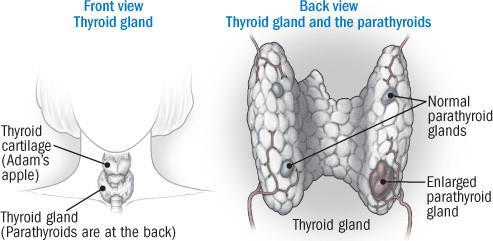
When parathyroid cells become cancerous, they multiply out of control. They usually form a firm, grayish-white tumor. The tumor can invade the thyroid gland and neck muscles.
As the cancerous cells grow, they usually produce too much PTH. This causes abnormally high levels of calcium in the blood (hypercalcemia). PTH can get so high that the bones pour out too much calcium. This can cause bone pain and lead to osteoporosis (thin, brittle bones).
Elevated levels of PTH also force the kidneys to retain large amounts of calcium, triggering the formation of kidney stones. Very high calcium can also cause kidney damage, dehydration, and confusion.
Parathyroid cancer most often occurs in adults in their 40s, 50s, and 60s. Because it is so rare, researchers have not determined whether specific environmental or lifestyle factors increase the risk of this cancer. Some cases seem to have a genetic link, with several generations of a single family affected.
Symptoms of parathyroid cancer
Symptoms of parathyroid cancer may include:
- a small lump in the front of the neck
- pain in the back or side and blood in the urine (caused by kidney stones)
- bone pain
- hoarseness (caused by cancer invading the vocal cords or their nerves)
- trouble swallowing
- constipation
- urinating more than normal
- weakness
- loss of appetite
- weight loss for no known reason
- vomiting
- confusion and other neurological changes.
An enlarged parathyroid gland does not necessarily mean you have cancer. The gland can be enlarged for other reasons. For example, a noncancerous tumor called a parathyroid adenoma can cause a parathyroid gland to enlarge.
Diagnosing parathyroid cancer
Most people with parathyroid cancer visit a doctor because they have kidney or bone problems - or both. He or she usually will ask about risk factors related to kidney and bone illnesses because parathyroid cancer is so rare. (A doctor may never see a single case despite practicing medicine for decades.)
Your doctor will begin with a thorough physical exam, including feeling your neck for any lumps. You will likely have basic laboratory tests, such as blood tests to look for elevated levels of calcium and parathyroid hormone. Depending on your symptoms, your doctor may order or special scans of your neck, bones, or kidneys.
The only way to confirm a diagnosis of parathyroid cancer is to remove the tumor and examine it under a microscope.
Expected duration of parathyroid cancer
Parathyroid cancer will continue to grow until it is treated.
Preventing parathyroid cancer
Because risk factors for parathyroid cancer remain unknown, there is currently no way to prevent it.
Treating parathyroid cancer
Treatment will depend on whether the cancer affects only your parathyroid gland or has spread (metastasized) to other areas.
If you the cancer is limited to your parathyroid, you will receive medication to control your blood calcium levels until you have surgery. Then the cancerous gland will be removed, along with part or all of the thyroid gland on the same side of your neck. In some cases, chemotherapy and radiation therapy are given as well, though with limited effectiveness.
If your cancer has spread beyond the gland, you will need surgery to remove as much of it as possible. This will help lower your PTH and blood calcium levels. Before and after surgery, you will need medication to help maintain normal blood calcium levels.
If you cannot have surgery, your high calcium can be controlled with medication. By measuring your PTH and calcium levels, doctors can monitor your response to treatment.
Patients with metastatic parathyroid cancer can choose to participate in clinical trials to evaluate new treatments. These may involve radiation, surgery with radiation, or chemotherapy. Clinical trials usually take place at large academic medical centers.
When to call a professional
Call your doctor promptly if you have symptoms of parathyroid cancer, especially if you have bone pain or a lump on your neck. Because this cancer is rare, your doctor should refer you to a specialized medical center for diagnosis and treatment.
Prognosis
Most patients diagnosed with parathyroid cancer have localized disease that can be treated surgically. However, even if the tumor is removed, the cancer can return. This usually happens within two to five years, but it may take more than a decade. Even if the cancer has spread, parathyroid cancer tends to grow slowly.
Additional info
National Cancer Institute (NCI)
www.cancer.gov
American Cancer Society (ACS)
www.cancer.org
American Association of Clinical Endocrinologists
www.aace.com
About the Reviewer

Howard E. LeWine, MD, Chief Medical Editor, Harvard Health Publishing; Editorial Advisory Board Member, Harvard Health Publishing
Disclaimer:
As a service to our readers, Harvard Health Publishing provides access to our library of archived content. Please note the date of last review or update on all articles.
No content on this site, regardless of date, should ever be used as a substitute for direct medical advice from your doctor or other qualified clinician.