










Advancements in knee replacement: More precise and personalized
High- and low-tech innovations enhance an already effective surgery.
- Reviewed by Jeffrey K. Lange, MD, Contributor
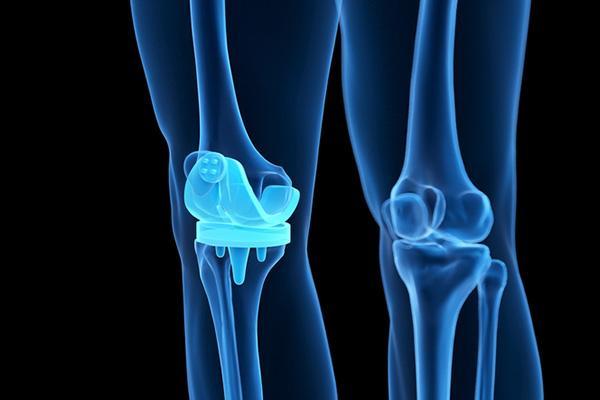
Total knee replacement is a highly successful surgery that relieves pain and restores physical function for about a million Americans with severe knee osteoarthritis every year.
During a knee replacement, the surgeon removes worn-out cartilage (the slippery substance that covers the ends of bones in joints) and some bone, then caps the two adjacent bone surfaces with an implant made of metal and plastic. The implant recreates the knee joint, allowing for pain-free movement in more than 90% of cases.
Room for improvement
But there’s always room for improvement. “We’re starting at a high baseline in terms of success, but there are still people who undergo knee replacement who don’t have as great an outcome as we’d like,” says Dr. Jeffrey K. Lange, an orthopedic surgeon at Harvard-affiliated Brigham and Women’s Hospital. “We keep developing new technologies to improve results for everyone.
The goals include helping people function better, reducing pain following surgery, and making implants last even longer than the typical 15 to 20 years.
Who needs knee replacement?If you have knee arthritis, it may be time to consider surgery when
|
More precise placement
To further these goals, surgeons can use highly accurate computerized robotic systems, also called navigation systems. “This tool lets us very precisely plan and execute the placement of the implant,” says Dr. Lange.
To make room for the knee implant, the surgeon must shave down the surfaces of the ends of the bones in the knee joint. Depending on the shape of the bones, “you can take a little, you can take a lot, and you can shave more in one direction than another,” says Dr. Lange. Surgeons perform the shaving accurately with conventional techniques, but robotic systems are even more precise.
Using imaging studies and digital technology, the robotic system assists the surgeon in planning the location of the cuts and then helps to make those cuts during surgery. Along with an exact fit of the implant and less cutting of bone, there’s less manipulation of soft tissues (muscles, tendons, and ligaments). Some studies show that this may result in reduced pain after surgery and easier rehabilitation. “We hope it will also make the implants last longer, but we can’t prove that yet,” says Dr. Lange.
High-tech implants
Knee implants themselves are also becoming more precise and personalized. One of the latest innovations is an implant that closely matches the patient’s own knee anatomy, with the help of 3D printing.
“We get a CT scan of a person’s knee and then create an implant using 3D printing that exactly matches those surfaces. This may feel more comfortable because your knee moves exactly the way you’re used to moving it,” says Dr. Lange.
“So far, these implants have a great track record, with some studies showing better patient satisfaction than with conventional implants,” says Dr. Lange. “But we need longer-term data to assess their ultimate performance.”
He adds that these implants “should be particularly helpful for people with slightly abnormal knee anatomy or people who’ve already had several knee surgeries.”
Rehab and pain control
Dr. Lange notes that the most important advancements over the last decade have been in the rehabilitation process and pain control around the time of surgery.
Hospitals use detailed care plans before, during, and after surgery. These plans help patients recover faster, stay out of the hospital after discharge, and have better pain control.
Before surgery, patients go through a program of education and physical therapy (known as prehabilitation, or prehab). During surgery, anesthesia and pain control methods are tailored to the individual to minimize pain while reducing the use of opioids. “After surgery, we get people up and walking early and have them go through a strong rehabilitation program,” says Dr. Lange.
In the future, the use of high-tech devices may further improve the rehabilitation process. For example, a new “smart” knee implant comes with a sensor that automatically gathers continuous real-time data. It can measure the range of motion of the knee, the amount of weight being placed on the knee, the distance a person walks, and more. The surgeon can then track the patient’s progress and quickly identify anything that might need to be addressed.
Image: © Sebastian Kaulitzki/Science Photo Library/Getty Images
About the Author

Lynne Christensen, Staff Writer
About the Reviewer

Jeffrey K. Lange, MD, Contributor
Disclaimer:
As a service to our readers, Harvard Health Publishing provides access to our library of archived content. Please note the date of last review or update on all articles.
No content on this site, regardless of date, should ever be used as a substitute for direct medical advice from your doctor or other qualified clinician.


