










Don't wait to get help for back pain
Starting back pain treatment early can prevent a short-term problem from becoming a chronic one.
- Reviewed by Scott Sheehan, PT, DPT, OCS, Contributor

Have you or anyone you know experienced back pain, particularly lower back pain? The answer is almost certainly yes.
“Low back pain is one of the most common musculoskeletal complaints,” says Scott Sheehan, a physical therapist at Harvard-affiliated Spaulding Rehabilitation. “Most of the time, it’s a consequence of poor posture, bad ergonomics, or unusual movement patterns.” Less commonly, low back pain can be due to a serious condition such as infection, cancer, or fracture.
Regardless of what’s causing your back to ache, don’t simply ignore it. When discomfort lingers, addressing the underlying problem can help keep a short-term issue from turning into a long-term one that’s harder to treat.
Complex anatomy
People often picture the spine as a stack of small bones (the vertebrae) — but it’s much more than that. Spiky projections at the back of each vertebra meet projections on the vertebra above and the one below, forming small joints (facet joints). These joints allow mobility while preventing excessive motion. Shock-absorbing spacers (discs) sit between the vertebrae. Bands of tissue (ligaments) connect the bones to one another, stabilizing the column. Layers of muscle attached to the vertebrae via tendons enable the spine to move, bend, twist, and stretch. They also support the spine.
The spinal cord runs down the middle of the vertebral column. Nerves, which carry signals to and from the brain through the spinal cord, exit through openings between the bones and extend to all parts of the body.
“The lower spine, called the lumbar spine, provides a base from which we move our bodies around,” says Sheehan. “Due to its complexity, there’s a lot of room for breakdown and failure.”
Mechanical causes
Most low back pain comes from stress and strain on the discs and facet joints. You might spend too much time working in the garden or cleaning the house. You may lift something too heavy or twist the wrong way. Suddenly, you feel sharp pain in your lower back. Or you may not notice any trouble until the next day, when muscle spasms and stiffness make it painful to move.
Poor posture and prolonged sitting can also cause backache. “These place excess strain on the lumbar spine and surrounding muscles, often resulting in a dull, aching discomfort,” says Sheehan.
Muscle imbalances, such as a weak core (which includes muscles in your abdomen, back, sides, pelvis, and buttocks) combined with tight hip flexors (the muscles at the fronts of the hips) or hamstrings (the muscles at the backs of the thighs), can alter the alignment of the spine. This increases stress on the lower back, potentially leading to pain and injury.
The aging spine
Back pain also stems from the natural effects of aging. Everyone experiences some degree of disc degeneration. When we’re young, the discs have a high water content. As we age, the water content decreases. “Dehydration of the discs starts a cascade of events,” says Sheehan.
The discs become thinner and flatter, reducing the distance between vertebrae and shortening the spine. This makes the openings where nerves exit the spinal canal smaller, which may encroach on a nerve. Or, a disc may actually rupture and press on nearby nerves, causing sciatica or other nerve problems.
With decreased disc height, facet joints become overloaded, which can lead to osteoarthritis. Ligaments, which normally stretch to match the exact distance between vertebrae, become slack when discs flatten. Loss of tension in the ligaments makes the vertebrae less stable, allowing them to shift slightly forward and backward. Over time, this small but repeated motion puts extra stress on the facet joints and can cause bone spurs (osteophytes) to form.
Why you shouldn’t wait
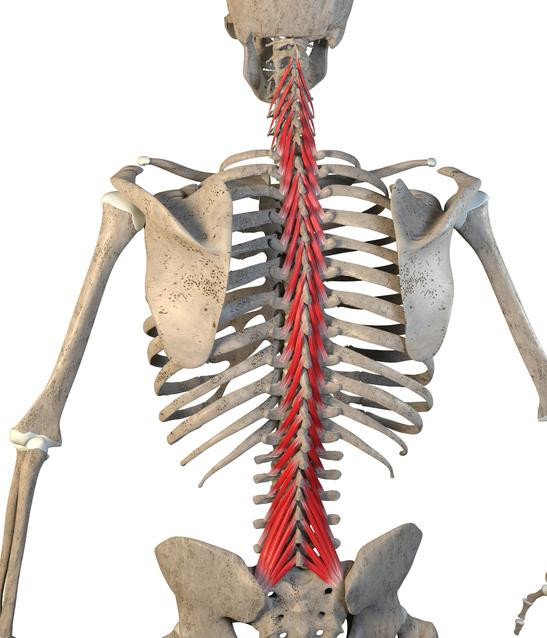
When you have back pain, your body automatically tries to protect the painful area. This protective reflex can cause nearby muscles to become less active, a process known as reflex inhibition. In the lower back, this is especially important for a key stabilizing muscle, called the lumbar multifidus.
If pain lasts for a long time, the muscle can weaken and eventually atrophy (shrink), with fat replacing healthy muscle tissue. Once this occurs, the muscle will not grow back. With less muscle support, the spine becomes less stable, making future injuries and chronic back pain more likely.
“To prevent this, I strongly recommended seeking care early for low back pain, especially if the pain is severe, if you experience pain that radiates from your back to anywhere in your buttocks or legs, or if you have weakness,” says Sheehan.
|
The multifidus muscle (shown in red) spans the length of the spine. The lower portion (called the lumbar multifidus) plays an important role in stabilizing the spine. Image: © madigraphics/Getty Images |
How to relieve low back pain
The initial treatment for back pain should be directed at the specific cause (if one can be found). Beyond that, it’s often helpful to take an over-the counter pain reliever and apply heat to soothe muscles and ice to reduce inflammation.
The mainstay of treatment for most back pain is physical therapy, involving exercises to help your back heal and to prevent further injury. A physical therapist may use hands-on techniques such as joint manipulation to reduce pain, making it easier for you to do exercises that enhance stability in the spine. The physical therapist can also show you better ways to move and position your body to reduce stress on the spine.
A stretch for low back painStretches and exercises should be individualized for each person, as the best choices vary depending on the cause of the problem. However, most people can benefit from decompressive exercises, which take weight off the joints and discs. Here’s one example. Knees to chest
Photo by Michael Carroll |

Image: © The Good Brigade/Getty Images
About the Author

Lynne Christensen, Staff Writer
About the Reviewer

Scott Sheehan, PT, DPT, OCS, Contributor
Disclaimer:
As a service to our readers, Harvard Health Publishing provides access to our library of archived content. Please note the date of last review or update on all articles.
No content on this site, regardless of date, should ever be used as a substitute for direct medical advice from your doctor or other qualified clinician.


