










New thinking about plaque in arteries that feed the brain
A recent study compared stents versus surgery for treating carotid artery stenosis. Could earlier, better drug therapy prevent the need for those invasive treatments?
- Reviewed by Peter Libby, MD, Contributor

Atherosclerosis, the fatty plaque that accumulates inside arteries, can occur throughout the body. That includes the arteries in the neck that deliver blood to the brain (see illustration). Known as carotid artery stenosis, this condition leaves people vulnerable to serious complications. If the plaque breaks open, a clot may form and travel up to the brain, interrupting blood flow and causing a stroke.
The best way to assess and reduce that dire but uncommon risk has long been controversial. However, recent advances have spurred new thinking about managing carotid artery stenosis, says cardiologist Dr. Peter Libby, the Mallinckrodt Professor of Medicine at Harvard Medical School. These include findings from a study comparing invasive procedures to treat carotid disease, as well as improved imaging techniques for detecting dangerous plaque in the carotid arteries.
"Still, healthy lifestyle habits remain the most important way to prevent and treat all forms of atherosclerosis," says Dr. Libby. Getting regular exercise and following a plant-forward eating pattern like the Mediterranean diet is essential, he stresses. Beyond that, many people also need medications to control their blood pressure, cholesterol, and blood sugar, as elevated values of these factors encourage plaque buildup and complications.
|
|
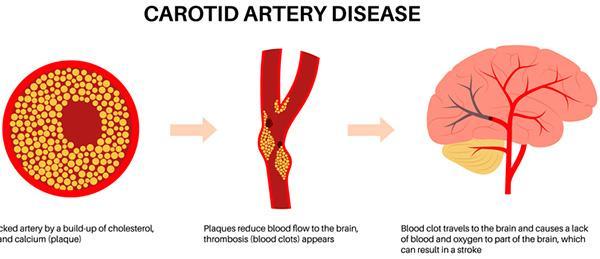
Stenting versus surgery: The latest evidence
People who have a severely narrowed carotid artery (greater than 70% blocked) are typically offered a procedure to treat the plaque; treatment may also be recommended with less narrowing if stroke or related symptoms develop. One option is the placement of a stent, a tiny metal coil that props open the artery. The other is an endarterectomy - a surgery that involves cutting open the artery and removing the plaque.
A study in the Nov. 21, 2025, issue of The New England Journal of Medicine found that people who received drug therapy plus a stent had fewer strokes and were less likely to die over the following four years than people who received just the medication. Endarterectomy offered no added benefit beyond medication alone. Of note: the study participants all had severe narrowing and none had recent symptoms of carotid stenosis (see "Signs and symptoms of carotid artery stenosis").
While the results add to cautions about endarterectomies, they don't necessarily mean stents are a good idea, says Dr. Libby. The first participants entered the trial starting in 2014. Back then, the targets for drug therapy weren't as strict as current guidelines recommend. "For example, the blood pressure targets are now lower. We now have medications that can dramatically reduce LDL [bad] cholesterol, including PCSK9 inhibitors such as alirocumab [Praluent], evolocumab [Repatha], and inclisiran [Leqvio]. Also, the new GLP-1 drugs for diabetes and obesity have proven benefits for lowering cardiovascular risk," says Dr. Libby.
Signs and symptoms of carotid artery stenosisCarotid artery stenosis usually doesn't cause symptoms unless the artery is severely restricted or completely blocked. One possible sign is a distinctive whooshing sound called a bruit (pronounced BREW-ee) that a doctor can hear though a stethoscope placed over the artery. For some people, the first symptom of carotid stenosis is a stroke. Others have a transient ischemic attack (TIA), or ministroke, which usually lasts only briefly and disappears within 24 hours. TIAs are a warning symptom of a full-blown stroke. Strokes and TIAs often include eye issues, most commonly a sudden loss of vision that people often describe as a curtain coming down over one eye. Others include trouble speaking or sudden weakness in the face, arms, or legs. If you have any of these symptoms, even if they pass quickly, call 911 right away. |
The problem of medication reluctance
But convincing people to take medications when they don't have any symptoms is challenging. "You don't feel high blood pressure or high cholesterol, so I spend a great deal of time my time trying to convince people to take medications to lower their risk," says Dr. Libby. What's more, the payoff is intangible - no one ever thanks you for the stroke they didn't have, he adds.
What about people who have a severely narrowed carotid artery and are wondering about undergoing a procedure to treat the plaque? Overall, today's medications are so much more effective that we may be able to forestall the need for invasive interventions, Dr. Libby says. In fact, there's a parallel trend for treating plaque in the coronary arteries with intensive drug therapy rather than a stent.
While stents for carotid artery stenosis are clearly appropriate in certain cases, they're controversial because in rare cases, the procedure can trigger a stroke. Dr. Libby's advice: work closely with your doctor to determine whether medications make sense for you. Some people may feel more secure receiving a stent. "My job is to educate people about the benefits and risks and be a partner in their decision," he says.
Refining risk and future directions
Increasingly, experts are recognizing that the degree of narrowing inside a carotid artery isn't enough information to assess the risk of stroke. Just like in the coronary arteries, plaques that grow outward may not cause a narrowing of the carotid arteries - but still can rupture and form dangerous clots. In the future, more precise imaging tests known as photon-counting CT scans may allow doctors to better characterize the different types of plaque in the neck and heart arteries, which may improve their ability to predict a person's risk, says Dr. Libby.
Image: © Cravetiger/Getty Images
About the Author

Julie Corliss, Executive Editor, Harvard Heart Letter
About the Reviewer

Peter Libby, MD, Contributor
Disclaimer:
As a service to our readers, Harvard Health Publishing provides access to our library of archived content. Please note the date of last review or update on all articles.
No content on this site, regardless of date, should ever be used as a substitute for direct medical advice from your doctor or other qualified clinician.


