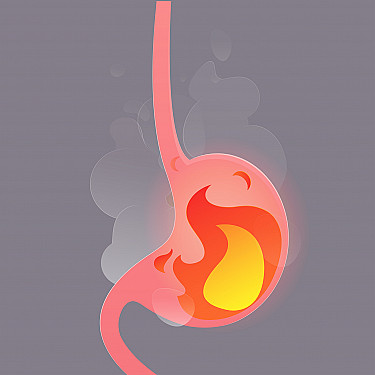
Medical myths: Does food cause ulcers?

There you are, having your pepperoni pizza when that feeling comes over you: pressure, burning, fullness in your upper abdomen, and a bitter taste in the back of your throat. To add insult to injury, your kid brother reminds you about your ulcer and how you had better start eating better. You wonder how you could ever get along with the diet recommended to you when the ulcer was first detected years ago.
And just like that, the myth about food causing ulcers is perpetuated.
The answer is no
It is now well established that foods have little or nothing to do with ulcer development. Food's true effect on ulcers is dwarfed by other, more important factors. But the word has not gotten out: many people cling to the now-disproven notion that if you have had an ulcer, you must be careful about what you eat for fear of making the ulcer worse or causing a new one.
Peptic ulcer disease refers to ulcers involving the lower part of the stomach and upper intestine (the duodenum) into which the stomach empties. Theories about cause have evolved over time, but for many years it was thought that the types of food you ate mattered: ones that stimulate acid secretion, are acidic themselves, or spicy foods that burn the mouth were all assumed to be important in causing or aggravating ulcers. However, in recent years, it has become clear that the vast majority of peptic ulcers have one of two causes:
- a bacterial infection (Helicobacter pylori)
- nonsteroidal anti-inflammatory drugs (NSAIDs, such as ibuprofen or aspirin).
A small percentage of ulcers are caused by other problems (such as excessive acid production or tumors). But foods, including spicy ones, coffee, and even alcohol play a minor or negligible role; alcohol can cause gastritis (stomach inflammation) but that's a different condition. In addition, frequent small meals with a bland diet and milk, time-honored recommendations for the ulcer patient, may actually lead to increased acid production. Milk may lead to reduced symptoms but should not be considered effective ulcer treatment. Smoking, on the other hand, is clearly associated with worse ulcer disease.
Why the myth persists
The myth about the role of foods in ulcer disease is difficult to debunk for several reasons, including:
- Publicity about the true causes of ulcer disease has been relatively minor outside of medical circles.
- It seems intuitive that spicy foods that must be bad for the stomach.
- There is widespread confusion between the symptoms of "heartburn" or other causes of abdominal pain and those of ulcer disease.
- There are dietary causes of other (non-ulcer) stomach trouble, such as gastritis.
Reflux versus ulcers
The symptom described as heartburn is usually due to gastroesophageal reflux disease (GERD), a condition that is much more common than ulcer disease. With GERD, acid from the stomach washes back (refluxes) into the lower part of the stomach and causes burning, pressure, belching, and a bitter taste; it is often worse after eating, especially if you lie down. Spicy foods may certainly provoke symptoms of GERD and if frequent, damage to the lower esophagus may lead to narrowing, difficulty swallowing, or other complications. Ulcer disease, on the other hand, usually causes upper abdominal pain that is relieved by eating and worse between meals, bleeding (causing black, tarry stools), or no symptoms at all. Effective treatments are available for both problems.
So, if you have GERD, by all means, avoid those foods that you have noticed worsen your symptoms, and if symptoms are frequent, talk to your doctor about treatment options.
But, if you have ulcer disease, avoid NSAIDs, find out (with your doctor's help) if you have H. pylori infection, and if you do, take the antibiotics that effectively eradicate the bacteria. And if your kid brother keeps pestering you about your diet, give him that lecture about his smoking.
Image: © Fotografia Inc./Getty Images
About the Author

Robert H. Shmerling, MD, Senior Faculty Editor, Harvard Health Publishing; Editorial Advisory Board Member, Harvard Health Publishing
Disclaimer:
As a service to our readers, Harvard Health Publishing provides access to our library of archived content. Please note the date of last review or update on all articles.
No content on this site, regardless of date, should ever be used as a substitute for direct medical advice from your doctor or other qualified clinician.