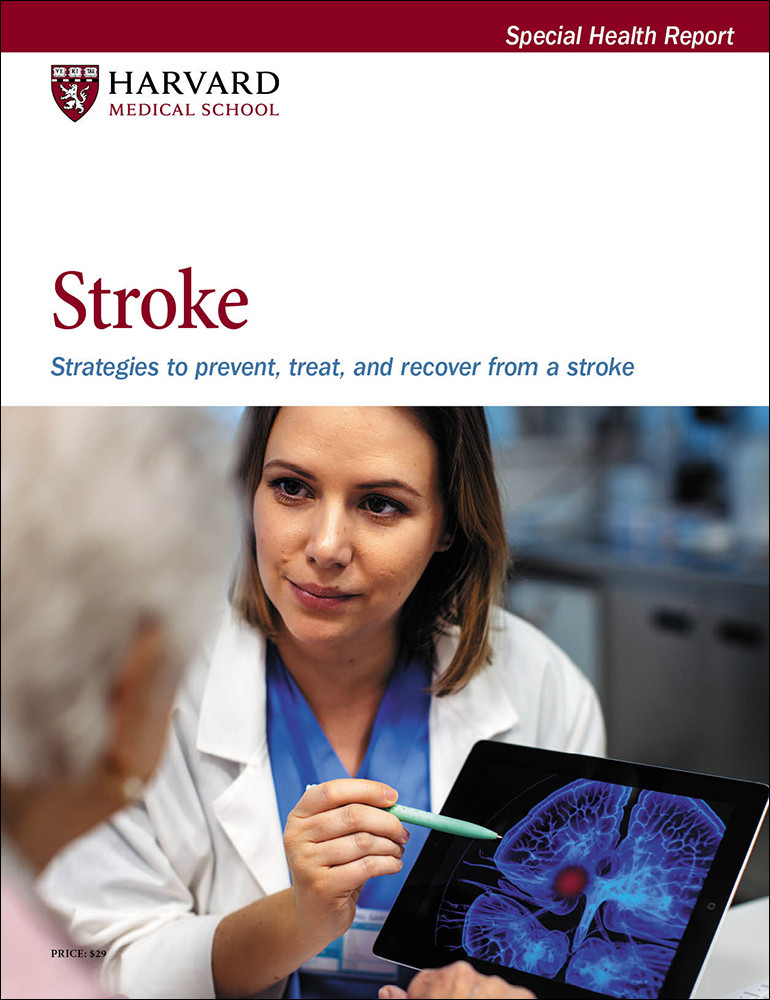
Stroke: Preventing and treating "brain
attack"
Printed
Version: $16.00
Electronic
Download (PDF): $16.00
Print
+ Electronic Download (PDF): $24.00
Stroke Symptoms & Treatment
Knowing the signs of a stroke and what to tell
the doctor when you arrive at the hospital can
make all the difference in the world—between
life and death, good health and disability. It
can preserve the ability to walk and talk, to
think, and to live independently. That’s
because protecting the brain from stroke damage
depends not only on getting prompt treatment,
but also on getting the right treatment.
Stroke is often referred to as a “brain
attack” because it can strike as suddenly
as a heart attack. And stroke—like heart
disease—is really all about what is happening
in the blood vessels. Which blood vessels are
affected, and how, will determine both diagnosis
and treatment.
Despite its prevalence, stroke is highly preventable.
In this report, you’ll learn how to assess
your risk of stroke and what you can do to reduce
it. You’ll learn about the latest medical
and surgical treatments for stroke, and find
an overview of rehabilitation specialists and
their techniques. Finally, this report explores
issues that your doctor may not cover, like the
emotional experiences common to people who have
suffered a stroke, with practical guidance on
easing the way to recovery. (updated: 2006)
Back to top >
Table of Contents:
- What is a stroke?
- Major types of
stroke
- New thinking
about TIAs
- Who is at risk?
- How to tell if
you’re having a stroke
- How the brain works
- A micro view
of the brain
- A macro view
of the brain
- When stroke strikes
- Subtypes and causes
of strokes
- Ischemic strokes
and TIAs
- Hemorrhagic strokes
- Diagnosing a stroke
- Physical examination
- Laboratory tests
- Imaging and blood-flow
studies
- Phase 1: Early,
hyperacute phase
- Phase 2: Acute
and subacute phase
- Phase 3: Secondary
prevention of stroke
- Treating hemorrhagic
stroke
- Coiling
- Surgery
- Medication
|
- Rehabilitation
- Assessing your
needs
- Rehabilitation
facilities and services
- Rehabilitation
specialists
- What to expect
- Life after stroke
- The emotional
impact of stroke
- Returning home
- Preventing stroke
- Know the risk
factors
- Lower your blood
pressure
- Lower your cholesterol
- Avoid tobacco
smoke
- Watch your weight
- Boost physical
activity
- Control diabetes
- Control other
risk factors
- Glossary
- Resources
- Books and Reports
- Organizations
|
Printed
Version: $16.00
Electronic
Download (PDF): $16.00
Print
+ Electronic Download (PDF): $24.00
Back to top >
Here's an
Excerpt from this Brain Stroke Special Health
Report
The two major types of stroke have different
causes. Ischemic strokes account for more than
80% of strokes and result from an interruption
in blood flow through a specific artery supplying
a specific area of the brain. Four basic types
of arterial pathologies can cause a blockage
that interferes with blood flow. When brain cells
die as a result of ischemic stroke, the resulting
injury to the brain is called a cerebral infarction.
Hemorrhagic strokes account for slightly less
than 20% of strokes and are caused by rupture
of a blood vessel either inside the skull, but
outside the brain (known as an extracerebral
hemorrhage) or inside the brain (intracerebral
hemorrhage). Once a blood vessel ruptures, the
resulting heavy bleeding (hemorrhage) tears through
the brain. This results in a mass of accumulated
blood known as a hematoma, which compresses nearby
brain tissue and interferes with its blood supply.
The initial arterial rupture has a specific pathological
cause that must be determined before treatment
can begin.
Whether a stroke is hemorrhagic or ischemic,
immediate treatment is crucial in limiting brain
damage. Starting treatment within minutes to
several hours can often limit the disability
caused by the stroke. As doctors often say, “Time
is brain.”
Printed
Version: $16.00
Electronic
Download (PDF): $16.00
Print
+ Electronic Download (PDF): $24.00
Back to top > |