

Light exposure at night may raise risk for heart disease

Whole grains may improve several heart risk factors at once

A lumbar belt may help ease low back pain

Children of centenarians may stay healthier and live longer too, study finds

Signs of pneumonia: Sometimes vague and unexpected

The surprising link between ovarian cancer and the fallopian tubes

Using a vibration plate: What it can — and can't — do for your body

People who walk more or walk faster live longer, study finds

For sleep apnea, a dental device may be as effective as CPAP

Rosacea treatments: What works?
Stress Archive
Articles

Review finds no sign of memory loss from statins
The best-quality evidence available does not prove that taking a statin can cause memory loss or other changes in mental functioning, according to a review in the Journal of General Internal Medicine. Since 2012, the FDA has required that statin manufacturers include a warning on drug packaging that statins could impair mental functioning, but this has been controversial. Researchers took a look at the published evidence for possible mental side effects of statins.
The new review covered randomized clinical trials involving nearly 47,000 people. Such trials are the gold standard in medical research. These included 23 trials in which researchers explicitly measured mental functioning, as well as trials that kept track of mental changes reported by participants.

Stressful job may raise stroke risk
Job strain—defined as having a demanding job in which you have little control—may slightly increase the risk of a stroke. The findings, in the February 2015 Stroke, echo earlier results that show a similar link between heart disease and job strain.
Researchers gleaned the results from 14 different studies that included more than 190,000 men and women from six European countries. Their average age was 42, and the follow-up lasted just over nine years, on average. Job strain was associated with a roughly 20% higher risk of ischemic stroke (the type that occurs when a clot blocks a blood vessel supplying the brain).

New concerns about anticholinergic medications
Anticholinergics, a group of medications that includes many over-the-counter and prescription drugs, are well known for causing confusion in older adults. Common medications with anticholinergic properties include medications to treat overactive bladder, such as oxybutynin (Ditropan); medications to treat allergies and sleeping problems, such as diphenhydramine (Benadryl, Sominex, Unisom); and medications used to treat depression, such as amitriptyline (Elavil). It's generally believed that confusion that may develop from anticholinergics clears up when someone stops taking the drugs. But now it appears that the medications are associated with a more permanent effect. A study published online Jan. 26, 2015, in JAMA Internal Medicine linked daily anticholinergic use among older adults for three or more years to an increased risk for developing dementia and Alzheimer's disease.
The study didn't prove that anticholinergics cause dementia; it only found an association between people who take the medications and people who develop dementia. Nevertheless, the researchers suggest that doctors avoid prescribing anticholinergics when possible, or at least limiting the medications to the lowest doses possible. If you're taking an anticholinergic, talk to your doctor about the risks the medication poses, including the risk of falls as a result of confusion.

Why you should thank your aging brain
At middle age, the brain begins to draw on more of its capacity for improved judgment and decision making.
If you forget a name or two, take longer to finish the crossword, or find it hard to manage two tasks at once, you're not on the road to dementia. What you're experiencing is your brain changing the way it works as you get older. And in many ways it's actually working better. Studies have shown that older people have better judgment, are better at making rational decisions, and are better able to screen out negativity than their juniors are.
Although it may take you a little longer to get to the solution, you're probably better at inductive and spatial reasoning at middle age than you were in your youth. |
Common drugs linked to dementia
Medications called anticholinergics are used to treat a host of conditions—overactive bladder, depression, allergies, and Parkinson's disease. They usually aren't recommended for older adults because one of the most common side effects is confusion and difficulty reasoning. Early studies have also indicated that long-term anticholinergic use is associated with an increased risk of dementia, and a recent study by researchers at the University of Washington adds more evidence to support that connection. The results were published online Jan. 26, 2015, by JAMA Internal Medicine.
The researchers tracked almost 3,500 men and women ages 65 and older who were free of dementia. When they matched prescription data for the previous 10 years with the participants' health outcomes, they determined that using anticholinergics was associated with an increased risk of developing dementia. Moreover, dementia risk increased with the dosage of the drugs and the length of time they were used. While people who had taken these drugs daily for the equivalent of three months had no increase in risk, those who had used them for over three years had a 54% greater risk than nonusers.

Music can boost memory and mood
Dan Cohen watches Mary Lou Thompson, who has Alzheimer's, respond to the playlist he made for her. Image: Photo Courtesy of BOND 360 |
By Dr. Anne Fabiny, Editor in Chief, Harvard Women's Health Watch

iPad can disrupt sleep, study suggests
Image: Thinkstock |
Using an iPad or other backlit electronic tablet in the hours before bedtime not only prevents you from falling asleep, it may also affect your alertness the next day, according to a report published in the Proceedings of the National Academy of Sciences, Dec. 22, 2014. Researchers at Harvard-affiliated Brigham and Women's Hospital found that the light emitted by the devices reset the body's circadian clock, which synchronizes the daily rhythm of sleep to daylight. As a result, people reading e-books took longer to fall asleep and were less alert the next morning than when they read print books instead.
During the two-week study, 12 men and women read digital books on an iPad for four hours before bedtime each night for five consecutive nights. They also followed the same routine using printed books. When they read the iPad, participants were less sleepy before bedtime but were less alert the following morning, even after eight hours of sleep.
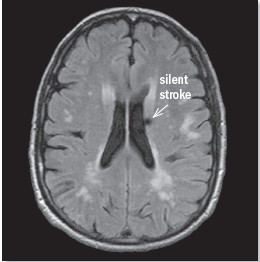
Reduce your risk of silent strokes
As seen on this MRI scan, a silent stroke |
Exercise, eat a healthy diet, and manage blood pressure and cholesterol to lower your odds.

Poor sleep linked to dementia and ministrokes
Images: Thinkstock |
Poor sleep is linked to high blood pressure, diabetes, obesity, and heart disease. Now a study published in Neurology Dec. 10, 2014, suggests that people with conditions that rob them of oxygen and deep sleep are more likely to have changes in the brain that may lead to dementia. Researchers say conditions such as emphysema and sleep apnea reduce the amount of oxygen in the blood during sleep, which can lead to silent, undetectable "ministrokes." Researchers also found that people who spend less time in deep sleep, called slow-wave sleep, are more likely to have loss of brain cells than people who spend more time in slow-wave sleep. Slow-wave sleep is important in processing new memories and remembering facts. The researchers noted that past evidence has shown that using a continuous positive airway pressure (CPAP) machine for obstructive sleep apnea may improve cognition, even after dementia has developed. "Sleep quantity and quality are important to maintain optimal health and prevent disease," says sleep expert Dr. Lawrence Epstein, an instructor in medicine at Harvard Medical School. "By getting enough sleep, you ensure that you are getting all the types of sleep, which is necessary to maintain proper functioning."

The problem with plaque: Even lesser amounts are still risky
Known as non-obstructive coronary artery disease, this condition can trigger heart attacks down the road.
You just had a cardiac stress test and you passed with flying colors. Does that mean you are free of heart attack risk? Not necessarily, says Dr. Ron Blankstein, assistant professor of medicine at Harvard Medical School and preventive cardiologist at Brigham and Women's Hospital.
Light exposure at night may raise risk for heart disease
Whole grains may improve several heart risk factors at once
A lumbar belt may help ease low back pain
Children of centenarians may stay healthier and live longer too, study finds
Signs of pneumonia: Sometimes vague and unexpected
The surprising link between ovarian cancer and the fallopian tubes
Using a vibration plate: What it can — and can't — do for your body
People who walk more or walk faster live longer, study finds
For sleep apnea, a dental device may be as effective as CPAP
Rosacea treatments: What works?
Free Healthbeat Signup
Get the latest in health news delivered to your inbox!
Sign Up
