







Battle of the bulge
Here's how to treat an abdominal deformation called diastasis recti.
- Reviewed by Lori Brightman, PT, MPT, CLT, Contributor
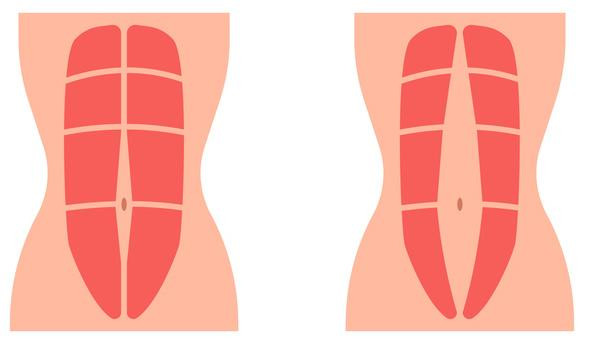
After a certain age, many adults notice their abdomen protruding more than it used to, perhaps with a visible bump or ridge. While this could simply be a sign of age-related weight gain, it may also be due to a condition known as diastasis recti.
What is diastasis recti?
The rectus abdominis muscle (the "six-pack") runs vertically along the front of the abdomen. A vertical band of tissue sits between the left and right sides. Diastasis recti occurs when the rectus abdominis separates along the midline. The resulting gap is at least two finger-widths wide and can be at, above, or below the navel. It can even run the entire length of the muscle.
"This muscle separation can happen in several ways," says Lori Brightman, a pelvic floor physical therapist with Harvard-affiliated Spaulding Rehabilitation.
Pregnancy is a common cause of diastasis recti. In addition, says Brightman, "Aging can cause the tissue between the rectus abdominis muscles to lose its elasticity, making it easier for the muscles to separate." Heavy lifting, coughing, rapid weight gain, and straining from constipation increase abdominal pressure, adding to the risk of muscle separation. Also, some genetic conditions, such as Ehlers-Danlos syndrome, affect normal collagen production throughout the body, weakening tissues like those in the abdominal midline.
Major abdominal surgery can also lead to diastasis recti. "The separation can occur from the incision through the abdominal muscles or from the buildup of scar tissue afterward," says Brightman.
Common symptoms of diastasis recti
The bulge can occur anywhere along the center line of the rectus abdominis, from beneath the sternum to the top of the pubic bone. While there may be some mild discomfort related to diastasis recti, it typically isn't painful.
People will often see a bigger bulge when lifting heavy objects, getting out of bed, or even performing everyday tasks. "Some people may also feel a soft bulge or a divot in the space between the left and right abdominals when they contract their abdominal muscles," says Brightman.
Diastasis recti exercises
Diastasis recti typically won't go away on its own. To help decrease the size of the separation and prevent it from getting worse, consider evaluation and exercise guidance from a physical therapist.
Physical therapists can provide detailed instruction on abdominal exercises and diaphragmatic breathing. "The exercises are designed to reduce the separation by training the muscles to move back toward the midline instead of gapping open," says Brightman. Diaphragmatic breathing works to activate the deep core muscles and provide additional strengthening, which also can help reduce the separation.
Physical therapists recommend a variety of abdominal exercises. Here's one example:
- Lie on your back with your knees bent and feet flat on the floor. If you are unable to safely lie on the floor, use a bed.
- Place a towel, sheet, or small blanket around your waist. Crisscross the ends in front of your abdomen and hold them.
- Take a deep breath in, and as you exhale, gently tighten your abdominal muscles and pull the ends of the towel outward, away from the midline. With your core engaged and the towel providing support, lift your head and shoulders, as if doing a small crunch. Keep your back flat against the floor.
- As you slowly lower your head and shoulders back down, release your grip on the towel, and inhale. This completes one rep. Repeat the movement 10 to 15 times to finish one set. Rest and do another set. "The second set can also be done later in the day," says Brightman.
Typical physical therapy sessions last 45 minutes and are done once a week for up to two months. However, the schedule may be adjusted to more or less often, depending on the individual. "Once a patient can correctly perform the exercises on their own, they can continue them at home for maintenance," says Brightman.
Avoiding activities that can worsen diastasis recti
Meanwhile, you should avoid exercises or movements that put excessive pressure on the abdominal muscles, such as sit-ups and crunches, as they can make the separation worse.
"If you practice yoga, you want to avoid or modify any core-related poses, like cobra pose and boat pose," says Brightman. "You also want to avoid holding your breath, especially when you're lifting, rising from a seated position, or getting out of bed."
If the diastasis recti persists, enlarges, or becomes painful, talk to your doctor about other options such as surgery.
Image: © Yulia Sutyagina/Getty Images
About the Author

Matthew Solan, Former Executive Editor, Harvard Men's Health Watch
About the Reviewer

Lori Brightman, PT, MPT, CLT, Contributor
Disclaimer:
As a service to our readers, Harvard Health Publishing provides access to our library of archived content. Please note the date of last review or update on all articles.
No content on this site, regardless of date, should ever be used as a substitute for direct medical advice from your doctor or other qualified clinician.