






Cholesterol's various forms
Learn more about cholesterol and how it moves through the body.
- Reviewed by Howard E. LeWine, MD, Chief Medical Editor, Harvard Health Publishing; Editorial Advisory Board Member, Harvard Health Publishing
Cholesterol is a fatty substance that occurs naturally in the body. It performs several vital functions. It is needed to make the walls surrounding the body's cells and is the basic material that is converted to certain hormones. Your body makes all the cholesterol you need. You need only a small amount of fat in your diet to make enough cholesterol to stay healthy.
There are two main types of cholesterol that circulate in the bloodstream: low-density lipoprotein (LDL) cholesterol and high-density lipoprotein (HDL) cholesterol. But cholesterol can't travel alone; it would end up as useless globs (imagine bacon fat floating in a pot of water). To avoid this problem, the body packages lipids (cholesterol and other types of fats like triglycerides) into minuscule protein-covered particles that mix easily with blood. These particles, called lipoproteins (lipid plus protein), move cholesterol throughout the body.

© arto_canon | Getty Images
LDL is known as "harmful" cholesterol because it is strongly associated with the buildup of artery-clogging plaques. It delivers cholesterol to virtually all the cells in the body.
Cholesterol and other lipids circulate in the bloodstream in several different forms. Of these, the one that gets the most attention is low-density lipoprotein-better known as LDL, or "harmful" cholesterol. But lipoproteins come in a range of shapes and sizes, and each type has its own tasks. They also morph from one form into another. These are the five main types:
- Chylomicrons are very large particles that mainly carry triglycerides (fatty acids from your food). They are made in the digestive system and so are influenced by what you eat.
- Very-low-density lipoprotein (VLDL) particles also carry triglycerides to tissues. But they are made by the liver. As the body's cells extract fatty acids from VLDLs, the particles turn into intermediate-density lipoproteins, and, with further extraction, into LDL particles.
- Intermediate-density lipoprotein (IDL) particles form as VLDLs give up their fatty acids. Some are removed rapidly by the liver, and some are changed into low-density lipoproteins.
- Low-density lipoprotein (LDL) particles are richer in pure cholesterol, since most of the triglycerides they carried are gone. LDL is known as "harmful" cholesterol because it delivers cholesterol to tissues and is strongly associated with the buildup of artery-clogging plaque.
- High-density lipoprotein (HDL) particles have varying properties, Some, but not all, work to help remove cholesterol from circulation and from artery walls and return it to the liver for excretion. They also vary in size, but they never become chylomicrons, VLDL, IDL, or LDL. They have a protein called apolipoprotein A, or apoA, on their surface, as opposed to the apoB in the LDL family of particles.
As the names of the main lipoproteins suggest, they have different densities. Chylomicrons and VLDL particles are the largest, fluffiest, and least dense. HDL particles are the smallest and most dense. Density isn't solely a matter of size, but also of the ratio of fat to protein in each particle. The higher the ratio-meaning the higher the fat content-the lower the particle density. Even among particles of a certain type, such as LDL and HDL, particle size and density can vary.
Beyond the five main lipoproteins, others exist, including alpha-lipoprotein, beta-lipoprotein, prebeta-lipoprotein, and lipoprotein(a). The latter has been an object of increasing concern and study in recent years.
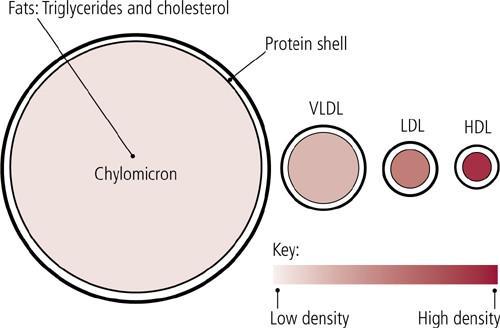
Figure 2: Particle density
© Harriet Greenfield
Lipoproteins-four kinds of which are shown in this diagram-circulate in the bloodstream. They carry and deliver cholesterol, triglycerides, and other substances to cells and tissues. The largest and lowest-density particle is the chylomicron, which contains mostly triglycerides. The smallest and densest particle is high-density lipoprotein (HDL, right), which contains less cholesterol and more protein and dense lipids.
About the Reviewer

Howard E. LeWine, MD, Chief Medical Editor, Harvard Health Publishing; Editorial Advisory Board Member, Harvard Health Publishing
Disclaimer:
As a service to our readers, Harvard Health Publishing provides access to our library of archived content. Please note the date of last review or update on all articles.
No content on this site, regardless of date, should ever be used as a substitute for direct medical advice from your doctor or other qualified clinician.