










Atherosclerosis: Can AI help your doctor detect it?
Artificial intelligence tools can reveal added detail about the amount and type of plaque in the heart's arteries. But whether that information can help prevent more heart attacks remains to be seen.
- Reviewed by Michael Lu, MD, MPH, Contributor
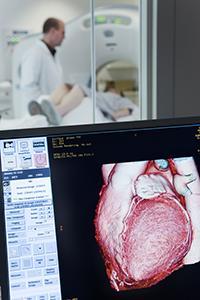 Atherosclerosis — an accumulation of plaque inside artery walls — is sometimes described as “hardening of the arteries.” But while some plaque is calcified and hard, some is not. Soft plaque is actually more dangerous because it’s more likely to rupture and form a clot that triggers a heart attack.
A specialized CT scan, coronary computed tomography angiography (CCTA), can detect both hard and soft plaque and blockages in the arteries feeding the heart. A number of medical device companies are marketing AI algorithms that further analyze the scans to quantify the amount of each type of plaque in the heart’s arteries. Earlier this year, some private insurance companies and Medicare began covering these AI-based reports, which cost $850 to $1,000 above the cost of CCTA itself.
Does the extra information from these AI-enhanced results make a meaningful difference? That is, could knowing more precisely how much soft and hard plaque you have change your doctor’s treatment recommendations? And would following that advice reduce your odds of experiencing a heart attack? “Right now, we really don’t know. But several studies to find out are currently under way,” says Dr. Michael Lu, director of artificial intelligence for the Cardiovascular Imaging Research Center at Harvard-affiliated Massachusetts General Hospital (see “Testing the promise of AI-based atherosclerosis analysis”).
Testing the promise of AI-based atherosclerosis analysisIn July 2026, 25 research sites around the United States, including Harvard-affiliated Massachusetts General Hospital, began recruiting people for an NIH-sponsored clinical trial seeking better ways prevent heart attacks. “The goal is to identify younger to middle-aged people with atherosclerosis and test different strategies, including AI-enhanced plaque analysis, to decrease coronary plaque,” says Harvard Medical School associate professor Dr. Michael Lu, co-principal investigator of the trial. For more information about the trial, which will finish around 2032, see https://preemptstudy.org. |
Traditional methods for detecting atherosclerosis
In the past, doctors relied on stress tests to check for atherosclerosis in the heart’s arteries. These tests monitor the heart’s electrical activity, muscle function, and blood flow patterns while the heart is under stress from exercise or medication. However, abnormal findings usually appear only when a person has one or more severely narrowed arteries (more than 70% blocked).
After an abnormal stress test result, the next test was often angiography, which involves inserting a catheter into an artery near the wrist or groin, guiding it up to the heart, and injecting a dye visible on x-ray. The resulting two-dimensional image reveals how well blood flows through the heart.
A coronary CT scan is faster and less invasive than traditional angiography. It involves an injection of dye in the arm, followed by multiple high-speed x-rays that create three-dimensional views of the heart’s blood vessels. It’s recommended as a first-line tool to evaluate people with chest pain or other symptoms that could be related to the heart.
A different imaging test, a coronary artery calcium (CAC) CT scan, also detects atherosclerosis. But it only “sees” hard, calcified plaque — not the soft, more dangerous type of plaque. A CAC CT is recommended to assess future heart attack risk only for people without symptoms and who are at borderline or medium risk for cardiovascular disease.
AI for atherosclerosis: Benefits and limitations
For years, CCTA has been used in clinical trials to track how soft plaque responds to medication, says Dr. Lu. “We start people on a drug or placebo, then do a repeat CCTA one or two years later,” he says. Currently, it takes a doctor an hour or more to manually review each scan to measure the volume of hard and soft plaque. In theory, AI could do that job much faster. But no AI application is 100% accurate, and the results would still need to be reviewed by a doctor, says Dr. Lu.
Currently, observational data suggest that AI plaque analysis adds helpful information that may lead to better care and heart health. “But many experts are waiting to see if AI-guided plaque analysis actually prevents more heart attacks and if the added cost is justified,” says Dr. Lu.
Image: © PhotoAlto/Frederic Cirou/Getty Images
About the Author

Julie Corliss, Executive Editor, Harvard Heart Letter
About the Reviewer

Michael Lu, MD, MPH, Contributor
Disclaimer:
As a service to our readers, Harvard Health Publishing provides access to our library of archived content. Please note the date of last review or update on all articles.
No content on this site, regardless of date, should ever be used as a substitute for direct medical advice from your doctor or other qualified clinician.


