










Why you should try ellipticals
These exercise machines work your heart and muscles for a low-impact, all-around routine.
- Reviewed by Corey Goldman, PT, DPT, CSCS, Contributor
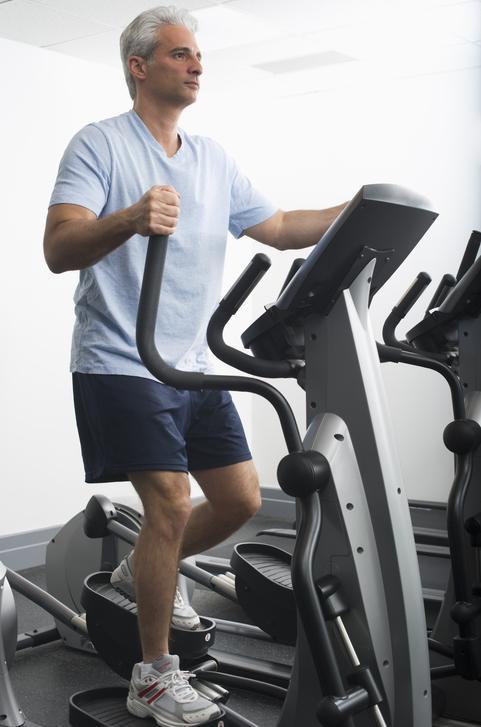 If you're looking for a way to combine cardio with strength training, then hop on an elliptical. "Ellipticals are a great all-in-one machine," says Corey Goldman, a physical therapist with Harvard-affiliated Spaulding Rehabilitation. "They offer a low-impact cardiovascular workout that simultaneously engages both the upper and lower body."
How elliptical machines work
An elliptical machine (also called a cross-trainer, a trainer, or simply an elliptical) is a stationary exercise machine that simulates walking, running, or stair climbing.
The machine has two large foot pedals and two handlebars. The pedals move back and forth in an elliptical (oval-shaped) pattern. The handlebars move in sync with the pedals to simultaneously exercise your arms, chest, shoulders, core, and back. Both the incline and resistance are adjustable to fine-tune your workouts. You can use ellipticals at the gym or in the home.
Low-impact exercise
Ellipticals offer a low-impact exercise, placing less stress on the knee, hip, and ankle joints. "With an elliptical, your feet don't come up and down off the steps, so the weight-bearing action is more moderate compared with running or walking," says Goldman. "This makes it ideal for people who have knee or hip osteoarthritis or are recovering from an injury." Ellipticals can also improve mobility by moving joints through their full range of motion, increasing blood flow to help joint function.
Starting out
Ellipticals are considered one of the easiest machines to use, but make sure to follow these basic guidelines to ensure your workouts are both effective and safe.
Maintain good posture. Keep your body upright and your feet flat on the pedals to better engage your core and prevent low-back strain.
Mind your grip. Avoid holding the arm handles too high or too tight, which can strain your shoulders and neck.
Find the resistance balance. "Set the handlebar and pedal resistance high enough to challenge your muscles but not so high that you can't maintain proper form," says Goldman.
Ellipticals might be challenging for people with mobility or balance issues, or individuals who have knee or ankle problems that affect their movement. Make sure to get approval from your doctor if these conditions apply to you.
Three elliptical workouts
Because of its versatility, an elliptical can be used for practically any type of workout or fitness goal. Goldman suggests newcomers start with a continuous steady tempo at a zero or low incline. "As you progress, make small gradual increases in resistance, speed, and incline," he says. A good starting duration is 15 to 20 minutes, but adjust the time as needed. When you're ready for a challenge, here are three workouts you can try.
Incline intervals. Set the machine to a light or moderate resistance and the incline to between 6% and 8%. Move at a steady pace for three minutes. Then reduce the incline to zero and continue for two minutes as a recovery. This completes one round. Repeat the cycle three or four more times.
High-intensity interval training. Set the resistance to a moderate-to-high level. Move for 40 seconds at a fast pace and then 20 seconds at a slower, cool-down pace, and repeat the cycle for the duration of your workout. You can adjust the timing as needed; for instance, you might move at a fast pace for 20 seconds, then a slower pace for 10 seconds. "Instead of focusing on speed, you can adjust the resistance to make it more difficult or easier," says Goldman.
Forward and backward intervals. Moving the pedals forward and then backward can engage all the lower-body muscles, particularly the hamstrings (in the backs of the thighs) and gluteals (in the buttocks) as you move forward, and the quadriceps (in the fronts of the thighs) and calves as you move backward. "Pedaling backwards can also increase the intensity with the additional effort required," says Goldman. Try this: pedal forward for three minutes, and then pedal backward for two minutes. Or shorten the intervals to two minutes and one minute, respectively.
Warm up and cool down with ellipticalsEllipticals are also ideal for dynamic warm-ups before your workouts and cool-downs after. For instance, do a five-minute warm-up at moderate speed and resistance, and 10 minutes at a slower pace and lighter resistance after your workout. "This can help prepare your body for exercise and helps cool it down afterwards, which can help your performance and reduce the risk of injury," says physical therapist Corey Goldman with Harvard-affiliated Spaulding Rehabilitation. |
Image: © Tetra Images/Getty Images
About the Author

Matthew Solan, Former Executive Editor, Harvard Men's Health Watch
About the Reviewer

Corey Goldman, PT, DPT, CSCS, Contributor
Disclaimer:
As a service to our readers, Harvard Health Publishing provides access to our library of archived content. Please note the date of last review or update on all articles.
No content on this site, regardless of date, should ever be used as a substitute for direct medical advice from your doctor or other qualified clinician.


