










The power of wall balls
Throwing a heavy ball at a wall provides a full-body workout in a single move.
- Reviewed by Kaitlyn Buckwell, MS, CSCS, TSAC-F, Contributor
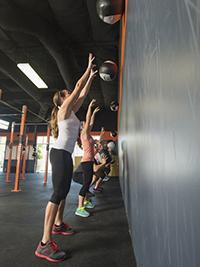 Bouncing a ball against a wall is one of the simplest pleasures of childhood. For adults, it's one of the best ways to increase strength, power, and endurance.
For wall ball exercises (commonly called "wall balls"), you squat with a large ball in your hands, then rise explosively, throwing the ball high against a wall. You complete the move by catching the ball and dropping back into a squat, ready for the next repetition.
Wall balls use lower-body strength and power while engaging multiple muscle groups at once: the chest, midsection, buttocks, legs, and shoulders. The steady up-and-down movement also boosts the heart rate.
"Not only are wall balls an effective full-body movement, but they also can improve your ability to perform daily tasks like lifting, reaching, and getting up and down from a seated position," says Kaitlyn Buckwell, a strength and conditioning specialist with the Center for Sports Performance and Research at Harvard-affiliated Mass General Brigham. "The constant throwing-and-catching motion can also improve coordination and balance."
Choosing the right wall ball
A wall ball is 14 inches in diameter (think of a large-sized pizza) with a soft synthetic leather or vinyl shell and a textured surface that makes it easier to throw and catch. You can purchase the balls online. They're also available at most gyms or stores that sell sporting goods.
Wall balls range in weight from 4 to 30 pounds. Beginners may want to start with a 6- to 8-pound ball, while people at more advanced fitness levels can usually begin with 10 pounds or heavier. "Your wall ball should always be heavy enough to make the exercise challenging but not so heavy as to compromise your form," says Buckwell.
How to perform wall balls
With any complex movement, proper technique is crucial. Consider enlisting a trainer to show you how to execute wall balls properly; the focus should always be on form and timing, not speed. Check with your doctor if you have any conditions or limitations that may affect your ability to do them safely.
- Stand two feet from a tall sturdy wall, feet shoulder-width apart. Hold the ball close to your chest, elbows at your sides.
- Squat as low as is comfortable, or until your thighs are parallel to the floor. If you have trouble with squats, do a modified version by sitting on an exercise box or bench.
- Explode upward into a standing position as you simultaneously throw the ball at a target on the wall about eight to 12 feet up.
- Catch the ball, then drop into a squat (or sit back down on the box or bench), holding the ball at chest level, ready for the next rep.
How hard and how many
The number of repetitions (reps) and sets should be based on your workout goal, according to Buckwell. For example:
Power. The emphasis of each rep should be on the upward movement.
Use a light ball and do three sets of three to five reps, resting a minute or two between sets.
Strength. Use a heavier ball and do three sets of six to eight reps, resting between sets.
Cardio. Do as many reps as possible for 30 seconds. Rest and repeat two or three times.
"To increase the difficulty, use heavier balls, do more reps, or throw at higher wall targets," says Buckwell.
Wall ball variations
The ball can be used for other types of exercises. Here are three that work different muscle groups.
Standing chest press
This exercise focuses on the shoulders, chest, and arms.
- Stand three feet from the wall, feet shoulder-width apart, ball at chest height.
- Slightly bend both knees.
- Tighten your abdominal muscles and throw the ball hard into the wall, catching it on its return.
- Continue to throw and catch the ball in a steady motion.
- Do five to 10 reps, rest, and repeat one or two times. As you progress, you can increase the speed and number of reps for more of a challenge.
Side toss
The rotational movement engages all the core muscles.
- Stand with slightly bent knees with the wall to your left, a little more than arm's length away.
- Hold the ball with both hands on your right hip.
- In one continuous motion, rotate your hips and torso toward the wall and explosively throw the ball against the wall with enough force that it bounces back so you can catch it with both hands.
- Bring the ball to your right hip as you rotate back to the starting position, and repeat for five to 10 reps.
- Turn around so the wall is now on your right. Position the ball on your left hip and do five to 10 reps to complete one set. Do two or three sets.
Forward lunge chest pass
This move targets the lower body, core, chest, arms, and balance.
- Stand five to six feet from the wall, holding the ball at chest level, with your feet hip-width apart.
- In one motion, lunge forward with the right foot and explosively throw the ball against the wall and let it fall to the ground.
- Retrieve the ball, return to your starting position and repeat the throwing movement while lunging forward with the left foot.
- Go back and forth until you've done three to five reps on each side to complete one set. Do two or three sets.
Image: © Erik Isakson/Getty Images
About the Author

Matthew Solan, Former Executive Editor, Harvard Men's Health Watch
About the Reviewer

Kaitlyn Buckwell, MS, CSCS, TSAC-F, Contributor
Disclaimer:
As a service to our readers, Harvard Health Publishing provides access to our library of archived content. Please note the date of last review or update on all articles.
No content on this site, regardless of date, should ever be used as a substitute for direct medical advice from your doctor or other qualified clinician.


