










Are lunges safe for older adults?
Lunges are an excellent exercise for maintaining vital leg strength.
- Reviewed by Christina Ruggeri, PT, DPT, NCS, Contributor
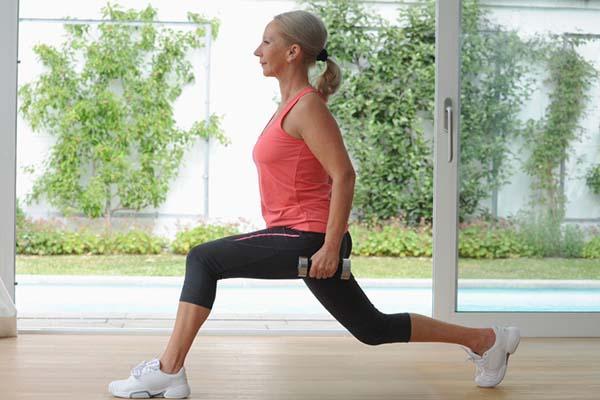
If you don't feel as strong as you once did, it's not surprising. Everyone loses muscle mass with age. Muscle weakness in the legs can make it difficult to get up from a chair, walk, or climb stairs. And it increases the risk of falling. But muscle weakness is not inevitable. You can build leg strength and stability with a targeted exercise routine. One recommended exercise is the lunge.
"A lot of my patients roll their eyes when I show them the lunge," says Christina Ruggeri, a physical therapist at Harvard-affiliated Spaulding Rehabilitation. "But this is an excellent exercise, especially for older adults."
What are lunges?
A lunge is a lower-body exercise that resembles a modified single-leg squat. For the basic forward lunge exercise, start with your legs together. Step forward so you are in a split stance, with one foot in front and the other behind. Bend your knees to lower your body, and return to a standing position. "Your back knee is going to essentially kiss the floor," says Ruggeri. Other variations include the reverse lunge, walking lunge, and side lunge.
The muscles worked during lunges are the quadriceps (front of the thigh), hamstrings (back of the thigh), and gluteal muscles (buttocks). This exercise also engages the hips, core, and back muscles.
Lunges are great for older adults because they help improve strength, flexibility, coordination, and balance. "You need these to do the lunge, and you also use them for basic daily activities like walking, negotiating stairs, or even getting up from the floor," says Ruggeri. If you're sitting on the floor playing with your grandchildren or you happen to fall and have trouble getting up, the way to push yourself back up is to work through the lunge position.
What you need to do the lunge
Lunges are generally safe for everyone, including older adults. But there are exceptions. "You must have the leg strength to do it correctly to prevent injury," says Ruggeri. "You shouldn't strain when doing a lunge." Straining can lead to muscle or tendon injuries that can take weeks to heal. People with significant knee, hip, or back problems should check with their doctor, a physical therapist, or personal trainer before starting an exercise program that includes lunges.
If you don't have sufficient leg strength, don't think that's a reason to avoid the lunge. Instead, work to build up the strength to do it. Start light, go slow, and progress when you feel strong enough.
Best lunge variations for seniors
"If someone attempts to do a lunge and they are struggling, I suggest starting with simple modifications," says Ruggeri. For example:
- Instead of lowering your back knee all the way toward the floor, go only halfway down or even less. Gradually increase the depth of the lunges.
- If you have balance issues, brace yourself next to a wall and then gently lower yourself down partway. You can also hold on to a railing or a cane for balance. If your right foot is forward, hold the support with your left hand for stability.
- Place your front foot on a low step or box to reduce the range of motion.
Once you've mastered the modified version, continue progressing until you can perform a full forward lunge. Ruggeri suggests starting with two sets of 10 lunges, going a quarter of the way down, for several weeks. Once you feel strong enough, do one set going halfway and one set going a quarter of the way. Keep increasing every few weeks.
If you're having difficulty with the forward lunge, try a reverse lunge by starting with your legs together and stepping backward into the lunge position. This can be easier on the knees. Another way to make lunges easier is to perform them in a pool. When you're exercising in water, the buoyancy of the water supports your body weight. You can practice lunges and other exercises with less stress on your joints.
Don't be in a rush. It takes about nine weeks of consistent training to build strength. Everyone progresses at a different pace. "Feel how your body is reacting to the exercise," says Ruggeri. "If you feel you're not there yet, stay at the same level until you're able to progress."
Other lunge variations
Once you've mastered the forward lunge, you can advance to other variations. For side lunges, step out to the side and bend your knee. This builds groin and hip strength. "This is more advanced because we don't walk sideways," says Ruggeri.
For a walking lunge, move forward with each lunge, alternating the legs. This requires greater balance and coordination.
Once you can do lunges easily, you can increase the difficulty by adding weights. Start by holding 5 pounds or less, and gradually increase the weight.
Alternatives to lunges for building strength
If you don't yet have the strength to do a lunge, you can start with the modifications described above or try a basic squat or sit-to-stand. For a sit-to-stand, stand in front of a chair and move as though you were sitting down, but instead, just tap the seat with your buttocks, and then stand up again.
If this is too difficult, place a pillow on the chair. Do two sets of 10, tapping the pillow. Continue working up until you can remove the pillow.
"Sit-to-stands are excellent for maintaining strength for functional activities, such as getting out of bed, off a toilet, and out of a car," says Ruggeri.
Forward lunge and lunge variations
Forward lunge
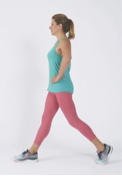
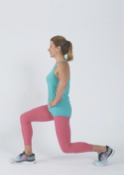
Stand up straight with your feet hip-width apart and your hands on your hips. Step forward with your right foot. Bend your knees and lower your torso straight down until your right thigh is nearly parallel to the floor. Hold, then return to the starting position. Repeat, stepping forward with your left foot.
Side lunge


Stand up straight with your feet placed wider than your hips, toes pointing forward, and your hands on your hips. Hinge forward at the hips, bend your right knee, and shift your weight to your right foot. Pause, then shift your weight to your left foot, bending your left knee and lunging to the left.
Reverse lunge
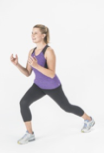
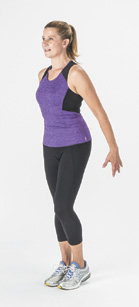
Stand with your feet hip width apart and your arms at your sides. Step back with your left foot, bending your right knee into a lunge. As you step, swing your arms forward, elbows bent, to help you balance. Return to the starting position. Repeat, stepping back with your right foot.
Image: © G&J Fey/Getty Images; exercise photos by Michael Carroll
About the Author

Lynne Christensen, Staff Writer
About the Reviewer

Christina Ruggeri, PT, DPT, NCS, Contributor
Disclaimer:
As a service to our readers, Harvard Health Publishing provides access to our library of archived content. Please note the date of last review or update on all articles.
No content on this site, regardless of date, should ever be used as a substitute for direct medical advice from your doctor or other qualified clinician.


