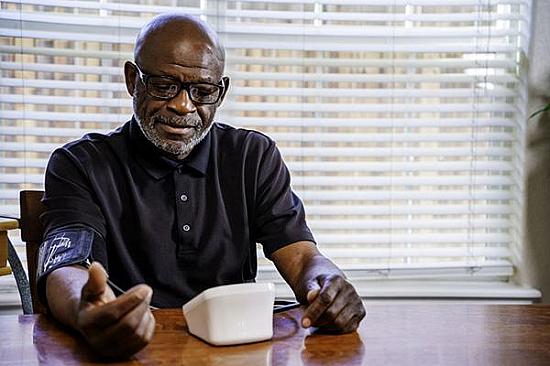
Monitoring blood pressure at home? Make sure you follow these steps
Learning how to take accurate at-home measurements can help your doctor diagnose or treat high blood pressure — a common condition that can harm the heart, kidneys, and brain.
- Reviewed by Howard E. LeWine, MD, Chief Medical Editor, Harvard Health Publishing; Editorial Advisory Board Member, Harvard Health Publishing

When was the last time you had your blood pressure checked? Nearly half of all adults have high blood pressure, or hypertension, but about a third of these people aren’t even aware they have the problem. For an accurate diagnosis, adults should have this simple test at least once a year.
If a blood pressure reading at your doctor’s office is elevated — that is, higher than a healthy range — current guidelines from the US Preventive Services Task Force recommend repeating the measurement outside of a clinic setting before starting treatment. But that’s not the only reason why your doctor may suggest regularly tracking your blood pressure at home.
Why monitor blood pressure at home?
Some people have elevated blood pressure only at the doctor’s office, which is known as white-coat hypertension. One of the best ways to know if your blood pressure is truly higher than normal is to measure it multiple times at home.
Home monitoring is especially a good idea if
- your doctor asks you to track readings to help decide if you need to start taking medication to lower blood pressure
- you’ve been diagnosed with high blood pressure and need to adjust your medications to make sure you’re reaching your blood pressure target
- you’re pregnant or had a baby in recent months and your health team is concerned about preeclampsia. This condition is a severe form of high blood pressure that can harm vital organs. When not promptly treated, it sometimes leads to seizures, stroke, or even death.
Which home blood pressure monitor should I buy?
Some simple guidelines to help you choose a blood pressure monitor for home use:
- Look for a monitor that’s been validated, which means the device has been independently reviewed for accuracy.
- Avoid monitors that feature cuffs used on the wrist or fingertip. These aren’t as accurate as upper-arm cuffs.
- Choose and use the right size cuff. Measure the circumference of your upper arm midway between your elbow and shoulder. Most home monitor cuffs can accommodate arm circumferences of 9 to 17 inches, but smaller and larger cuffs are available. A too-small cuff can lead to an artificially high reading, while a loose cuff can give a falsely low reading.
Very basic models cost as little as $25. But more expensive models, which range from about $50 to $100, may be more convenient to use. They can store multiple readings and send the data to your computer or smartphone — or even directly to the patient portal at your doctor’s office.
Three key points about blood pressure readings
To get the most useful information from home blood pressure monitoring, keep the following in mind:
- Blood pressure fluctuates throughout the day, which means one isolated reading doesn’t provide accurate information.
- If you check your blood pressure when you’re upset or stressed, it’s likely to be high. If you take it again right away, you may get another high reading, which can feed a cycle of anxiety and elevated readings.
- Consistent, repeated measurements provide a far more useful assessment than occasional readings.
Ask your doctor how often and at what time of day to take your blood pressure.
How can you get an accurate blood pressure reading?
Common mistakes can raise your blood pressure reading by a few points, or as much as 10 or even up to 25 points in some cases. Here’s what to do or avoid — and why — for an accurate blood pressure reading.
Wait at least 30 minutes after smoking, consuming caffeine or alcohol, or exercising before taking blood pressure.
Why? Caffeine and nicotine constrict blood vessels and boost your heart rate, which can raise blood pressure. Alcohol dilates blood vessels, possibly lowering blood pressure. And exercise increases heart rate and blood pressure.
Empty your bladder.
Why? A full bladder can put pressure on and reduce blood flow to your kidneys. Your body’s natural response is to raise your blood pressure to make sure your kidneys are getting enough blood.
Sit comfortably, supporting your arm near heart height. Sit back in your chair with your feet flat on the floor, legs and ankles uncrossed, and your arm extended, palm up, on a table so that your elbow is positioned roughly at heart height.
Why? Crossing your legs, especially at the knee, temporarily raises blood pressure. If your feet or your arm are not supported, your muscles will contract. Even this small amount of isometric exercise can raise your blood pressure. Also, supporting your arm below or above the level of your heart may affect the accuracy of the reading.
Wait a few quiet minutes before taking a reading. First, wrap the proper size cuff around your bare arm about an inch above the crook of your elbow. Sit quietly for a few minutes without distractions like TV, reading, phone scrolling, or talking. Then start the machine to take your blood pressure.
Why? Putting the cuff over clothes — or pushing up your sleeve so that it’s tight around your upper arm — may interfere with an accurate reading,. Ideally, you want to record blood pressure while feeling relaxed, not distracted, because even minor stress or tension can raise your blood pressure.
This video from the American Heart Association demonstrates the correct technique for taking your blood pressure at home.
Image: © Dusan Stankovic/Getty Images
About the Author

Julie Corliss, Executive Editor, Harvard Heart Letter
About the Reviewer

Howard E. LeWine, MD, Chief Medical Editor, Harvard Health Publishing; Editorial Advisory Board Member, Harvard Health Publishing
Disclaimer:
As a service to our readers, Harvard Health Publishing provides access to our library of archived content. Please note the date of last review or update on all articles.
No content on this site, regardless of date, should ever be used as a substitute for direct medical advice from your doctor or other qualified clinician.