
Fatty liver disease: Should you be tested?

Weight-loss drug may lower risk of heart attacks and infections

Testosterone therapy without evidence of deficiency may boost heart risk

Even a little exercise linked with lower stroke risk in people with afib

Antihistamines may not offer meaningful relief from eczema symptoms

What to eat on the DASH diet

Tricep workouts you can do at home

FDA approves first mRNA-based flu vaccine

Migraine: How it's diagnosed and what that means

Mindfulness practices to reduce stress and improve focus
Social engagement and relationships Archive
Articles

What is in a food label? You may be surprised
Terms like "healthy" or "natural" can be meaningless or misleading.
Image: Dragon Images/iStock
If you're like most nutrition-minded shoppers, the word "healthy" on the front of a package can be a big draw. "When you're stuck in a situation where processed foods are the only thing available to you, it can be helpful to know which foods are healthier than others," says Dr. Walter Willett, chair of the Department of Nutrition at the Harvard T.H. Chan School of Public Health.
Yet these days you're on shaky nutritional ground if you rely on front-of-package claims like "healthy" to determine which soup, sauce, cereal—or other canned, bottled, boxed, or bagged food—is the best choice. A food marked "healthy" may be loaded with sugar or refined carbohydrates.

Look on the bright side and maybe even live longer
Studies suggest that adopting a sunnier outlook may improve your health and even extend your life.
Image: © lzf /Thinkstock
In these turbulent times, it's sometimes a struggle to maintain a glass-half-full view of life. But if you can, it may serve you well. A growing body of research links optimism—a sense that all will be well—to a lower risk for mental or physical health issues and to better odds of a longer life.
One of the largest such studies was led by researchers Dr. Kaitlin Hagan and Dr. Eric Kim at Harvard's T.H. Chan School of Public Health. Their team analyzed data from 70,000 women in the Nurses' Health Study who, in 2004, had answered questions about how they viewed their futures

Take steps to prevent or reverse stress-related health problems
The relaxation response appears to manage stress and some chronic conditions at the deepest levels.
Image: © XiXinXing/Thinkstock
Chronic stress takes a toll on the body: it contributes to everything from high blood pressure and heart disease to anxiety, digestive disorders, and slow wound healing. On the flip side, managing stress helps control many chronic conditions or reduce your risk for developing them. Strategies include regular exercise, a healthy diet, and better sleep. And one strategy in particular—eliciting the relaxation response—may enable you to manage stress right down to your genes.
The anti-stressor
Relaxation response and genes
In the past decade, several studies from the Benson-Henry Institute have suggested that the relaxation response is associated with changes in genes that influence health. Among the findings are effects on the following:
Blood pressure. The relaxation response may activate genes associated with dilating the blood vessels and reduce activity of genes associated with blood vessel narrowing and inflammation. "It increases nitric oxide production, which in-creases the elasticity of the blood vessels and relaxes them," says Dr. Mehta. That can help lower blood pressure.
Blood sugar. The relaxation response may improve insulin activity by activating genes that help to control blood sugar.
Digestion. The relaxation response may reduce the activity of genes directly linked to the processes of inflammatory bowel disease (including Crohn's disease and ulcerative colitis). "Stress stimulates the digestive tract, which may cause diarrhea or nausea. The relaxation response returns gastrointestinal movement to a balanced state," explains Dr. Mehta.
Inflammation. "The relaxation response appears to turn off genes implicated in inflammation, and the stress response itself," says Dr. Mehta. While we need inflammation to fight infection and heal the body, chronic stress puts the body in a constant state of inflammation. That can increase plaque buildup inside coronary arteries, which may raise the risk for heart attack, stroke, and chest pain, and can also trigger unregulated cell growth, contributing to cancer risk. Does this mean the relaxation response can prevent health problems, or even reverse health problems that have already appeared? "It's encouraging, and we are studying that question right now," says Dr. Mehta.
Trigger the response
More ways to get there
Other techniques that evoke the relaxation response include mindfulness meditation, tai chi, yoga, and the following methods.
Focused breathing. Focusing on slow, deep breaths can be calming. Make sure your belly moves in and out as you breathe.
A body scan. Concentrate on one part of the body. Imagine it is open, warm, and relaxed, and that you are releasing tension from that area. Move on to another body part and repeat the process.
Guided imagery. Create a soothing scene in your mind that makes you feel relaxed. It may be a place or an experience. Allow your senses to be involved, imagining the smells you are encountering, the sounds you are hearing, and the ways things feel in your hands.
Repetitive prayer. Repeat a favorite prayer from your faith either silently or out loud. You can use a guide (such as your breathing or a rosary) to help with the repetition.
For more information, contact the Benson-Henry Institute for Mind Body Medicine at 617-643-6090 or www.bensonhenryinstitute.org.

Find your exercise fit!
Figuring out the exercise style that best suits your needs will help you stick to a plan.
Image: © iStock
Making a plan to get regular exercise can be challenging. There are many options, and you may not be sure how to narrow them down. "The result may be that you put off exercising," says Madhuri Kale, a physical therapist at Harvard-affiliated Brigham and Women's Hospital.
It helps to know the basic categories of activity you can choose from: exercise classes, gym workouts, home workouts, and vigorous work or recreational activity. Here are some pros and cons to consider for each.

6 ways to stay on your medication plan
Take control by using helpful gadgets and talking to your doctor about reducing your medications.
Image: © Wavebreakmedia/Thinkstock
There are many reasons why people are unable to stick to a medication regimen prescribed by a doctor, such as high costs or drug side effects. Often, those issues can be resolved by asking your doctor if a switch to another drug will help.
Another reason for what doctors call "non-adherence": too many pills and confusion about taking them. "It is a bigger problem than organization, and not always the patient's fault. Often providers write too many prescriptions without explaining them, or create a complicated schedule," says Dr. Sarah Berry, a geriatrician and assistant professor at Harvard Medical School.

Rx for longer life: Maintain healthy habits
It appears that the risk of an early death falls with each additional healthy lifestyle behavior that is maintained, even in people who are overweight.

Is health anxiety linked to heart disease?
It appears that health anxiety may be associated with a greater risk for developing heart disease.
Emergencies and First Aid - Emergency Checklist
This list describes your priorities in an emergency situation. Follow these steps:
- Evaluate the scene to protect yourself and others from injury or danger.
- Be calm and reassuring.
- Do not move the person unless he or she is in imminent danger or unless you cannot provide assistance without moving the person.
- Get help. Call out for someone to phone 911 or, if the person does not need immediate assistance, make the call yourself.
- If the situation is a choking emergency, perform the Heimlich maneuver (see Choking).
- Look, listen, and feel for breathing (see Breathing Difficulties).
- Feel for a pulse to determine if the heart is beating.
- Control bleeding with direct pressure.
- Treat for shock.
- If the person is unconscious, move him or her into the recovery position.
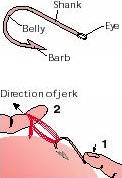
Emergencies and First Aid - Removing a Fishhook
Removing a Fishhook
Never remove a fishhook that is embedded in the eye or face; seek medical attention immediately to have it removed. A fishhook embedded in skin should be removed by a doctor. If you are in a remote area and a doctor is not available, remove the fishhook following the directions in the illustration below. If the fishhook is embedded deeply in tissue, follow the instructions below for a multibarbed fishhook.
A multibarbed fishhook should ideally be removed by a physician. If this is not possible, cut the eye off the shank of the hook, and then push the shank of the hook through the wound, following the path of the hook until the barbs exit and can be grasped with pliers. Flush the area well with running water, clean it with soap and water, and cover it with a bandage.

Emergencies and First Aid - Recovery Position
Adult Recovery Position
This position helps a semiconscious or unconscious person breathe and permits fluids to drain from the nose and throat so they are not breathed in. If the person is unconscious or semiconscious after you have done everything on the Emergency Checklist, move the person into the recovery position while waiting for help to arrive.
Do not use the recovery position if the person has a major injury, such as a back or neck injury
Fatty liver disease: Should you be tested?
Weight-loss drug may lower risk of heart attacks and infections
Testosterone therapy without evidence of deficiency may boost heart risk
Even a little exercise linked with lower stroke risk in people with afib
Antihistamines may not offer meaningful relief from eczema symptoms
What to eat on the DASH diet
Tricep workouts you can do at home
FDA approves first mRNA-based flu vaccine
Migraine: How it's diagnosed and what that means
Mindfulness practices to reduce stress and improve focus
Free Healthbeat Signup
Get the latest in health news delivered to your inbox!
Sign Up
