










What happens during a transesophageal echocardiogram for heart valve problems?
Ask the doctor
Q. My husband has a severe leakage in one of his heart valves. He will undergo a test where a tube will be placed down his throat to find out what type of surgery will be needed. Could you tell us what to expect?
A. The test he will be having is called a transesophageal echocardiogram. This test is used when a standard echocardiogram (called a transthoracic echocardiogram) does not provide the detail the doctor needs.
Both tests use ultrasound waves to get a picture of the heart. During a standard echocardiogram, the technician places a wand on the chest and moves it to different positions while viewing the images on a screen. No special preparation is needed for a transthoracic echo.
The transesophageal echocardiogram uses the same technology. However, it is more involved. First, your husband needs to have someone drive him home after the test. This is because he will receive medication that will make him sleepy.
He should not have anything to eat or drink for at least six hours before the test. He may be able to drink a little water up to two hours before the test, but he should follow the instructions he receives from the doctor's office.
The nurse will place an intravenous needle in his arm. Your husband will get medication to help him relax through this IV. His vital signs will be closely monitored throughout the test, including his
- heart rate
- blood pressure
- oxygen level
- heart's electrical pattern (electrocardiograph monitoring).
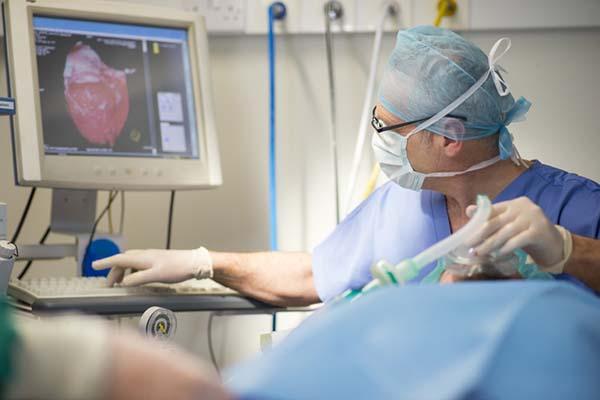
The doctor will numb the back of your husband's throat with a spray. Next, a thin tube, called an endoscope, will be inserted in his mouth. There is a small device attached to the tube that creates and picks up sound waves. The device is similar to the wand used for a transthoracic echo — it's just smaller.
Your husband will be encouraged to swallow as the doctor gently pushes the tube down his throat and into his esophagus. The tube is advanced while ultrasound pictures are transmitted to a screen. The tip of the tube will be moved around to shoot the sound waves at different angles.
Some people experience difficulty having a tube in their mouth. But once it moves into the esophagus, there should not be any pain. The test takes about 60 minutes or a little longer.
While your husband is still drowsy, the tube is removed. Your husband will rest for a while and be released once he is fully awake. The doctor that performed the test will send a report of his findings to your husband's heart doctor and heart surgeon. One or both of them will likely contact your husband in three to four days to describe the findings and the type of surgery he will need.
Image: © sturti/Getty Images
About the Author

Howard E. LeWine, MD, Chief Medical Editor, Harvard Health Publishing; Editorial Advisory Board Member, Harvard Health Publishing
Disclaimer:
As a service to our readers, Harvard Health Publishing provides access to our library of archived content. Please note the date of last review or update on all articles.
No content on this site, regardless of date, should ever be used as a substitute for direct medical advice from your doctor or other qualified clinician.


