
Reading the current blood pressure guidelines

Oat vs. dairy milk: Nutrition, benefits, and downsides

Microplastics: A hidden health threat?

Healing after food poisoning

What is tempeh? Benefits, nutrition, and how to use it

Light exposure at night may raise risk for heart disease

Whole grains may improve several heart risk factors at once

A lumbar belt may help ease low back pain

Children of centenarians may stay healthier and live longer too, study finds

Signs of pneumonia: Sometimes vague and unexpected
Physical activity and exercise Archive
Articles

Aerobic Fitness Test: The Step Method
To help assess your aerobic fitness, here is a minimum standard: See if you can walk up five flights of stairs at your own pace without stopping, using the railing only for balance. The test may seem too simple to be useful, but in the days before sophisticated exercise tests were widely available, thoracic surgeons used this very test to see if their patients were fit enough to undergo lung operations. In modern terms, people who pass the five-flight test have maximum oxygen uptake values of at least 20. That level will get you through surgery and daily life, but healthy people should use exercise to build up to levels two or even three times higher.
It is unlikely that a health club would ask you to use the stairwell for self-assessment, but it might well use a single 12-inch step or bench to evaluate your fitness. With just a little help, you can do it yourself. Ask someone to time you and count for you so you can concentrate on the task at hand (or foot!). At the signal to begin, step up with your right foot, then bring your left foot up beside it. Follow the "up, up" with "down, down" to complete one step. Repeat at a rate of 24 steps per minute for three consecutive minutes. Then rest in a chair for exactly one minute before taking your pulse. Finally, use the YMCA standards (see table below) to see how you stack up.


Is health anxiety linked to heart disease?
It appears that health anxiety may be associated with a greater risk for developing heart disease.
Emergencies and First Aid - Emergency Checklist
This list describes your priorities in an emergency situation. Follow these steps:
- Evaluate the scene to protect yourself and others from injury or danger.
- Be calm and reassuring.
- Do not move the person unless he or she is in imminent danger or unless you cannot provide assistance without moving the person.
- Get help. Call out for someone to phone 911 or, if the person does not need immediate assistance, make the call yourself.
- If the situation is a choking emergency, perform the Heimlich maneuver (see Choking).
- Look, listen, and feel for breathing (see Breathing Difficulties).
- Feel for a pulse to determine if the heart is beating.
- Control bleeding with direct pressure.
- Treat for shock.
- If the person is unconscious, move him or her into the recovery position.
Emergencies and First Aid - Removing a Fishhook
Removing a Fishhook
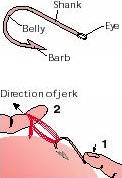
Never remove a fishhook that is embedded in the eye or face; seek medical attention immediately to have it removed. A fishhook embedded in skin should be removed by a doctor. If you are in a remote area and a doctor is not available, remove the fishhook following the directions in the illustration below. If the fishhook is embedded deeply in tissue, follow the instructions below for a multibarbed fishhook.
A multibarbed fishhook should ideally be removed by a physician. If this is not possible, cut the eye off the shank of the hook, and then push the shank of the hook through the wound, following the path of the hook until the barbs exit and can be grasped with pliers. Flush the area well with running water, clean it with soap and water, and cover it with a bandage.

Emergencies and First Aid - Recovery Position
Adult Recovery Position
This position helps a semiconscious or unconscious person breathe and permits fluids to drain from the nose and throat so they are not breathed in. If the person is unconscious or semiconscious after you have done everything on the Emergency Checklist, move the person into the recovery position while waiting for help to arrive.
Do not use the recovery position if the person has a major injury, such as a back or neck injury

Emergencies and First Aid - Removing a Speck From the Eye
Removing a Speck From the Eye
Occasionally, an eyelash or speck of dirt gets into the eye and causes irritation. If tears that form do not wash out the object, it can sometimes be removed by pulling the upper eyelid down over the lower eyelid. The lashes of the lower eyelid may brush out any foreign object that is caught under the upper lid.
If this does not work, try either of the procedures described below.

Emergencies and First Aid - Removing a Stuck Ring
Removing a Stuck Ring
| ||||
Emergencies and First Aid - Choking
Choking
A person who is choking will instinctively grab at the throat. The person also may panic, gasp for breath, turn blue, or be unconscious. If the person can cough or speak, he or she is getting air. Nothing should be done.
Immediate care
If the person cannot cough or speak, begin the Heimlich maneuver immediately to dislodge the object blocking the windpipe. The Heimlich maneuver creates an artificial cough by forcing the diaphragm up toward the lungs.
Reading the current blood pressure guidelines
Oat vs. dairy milk: Nutrition, benefits, and downsides
Microplastics: A hidden health threat?
Healing after food poisoning
What is tempeh? Benefits, nutrition, and how to use it
Light exposure at night may raise risk for heart disease
Whole grains may improve several heart risk factors at once
A lumbar belt may help ease low back pain
Children of centenarians may stay healthier and live longer too, study finds
Signs of pneumonia: Sometimes vague and unexpected
Free Healthbeat Signup
Get the latest in health news delivered to your inbox!
Sign Up
