

Reading the current blood pressure guidelines

Oat vs. dairy milk: Nutrition, benefits, and downsides

Microplastics: A hidden health threat?

Healing after food poisoning

What is tempeh? Benefits, nutrition, and how to use it

Light exposure at night may raise risk for heart disease

Whole grains may improve several heart risk factors at once

A lumbar belt may help ease low back pain

Children of centenarians may stay healthier and live longer too, study finds

Signs of pneumonia: Sometimes vague and unexpected
Nerve pain (neuropathic pain) Archive
Articles

Just 45 minutes of weekly activity may help with arthritis
In the journals
Studies have shown that regular activity can help older adults with arthritis stay independent. How much is enough? Research published online Dec. 28, 2016, by Arthritis Care & Research suggests you may need as little as 45 minutes per week.
Federal guidelines recommend 150 minutes of moderate activity per week to prevent premature death and serious illness. However, reaching that number is tough to reach for people with arthritis; in fact, only one in eight men with knee arthritis meet this standard. In this study, researchers tracked several years of fitness activity for 1,629 adults (44% of whom were men), ages 49 to 83, with osteoarthritis in the hip, knee, foot, or some combination. Specific exercises or activities were not recorded, only the time invested per week.


Could that joint pain be rheumatoid arthritis?
How to distinguish the symptoms from other conditions, and what to do about treatment.
Image: © PositiveFocus/Thinkstock
When your joints ache, you may chalk it up to an old injury or to osteoarthritis — the wearing away of cartilage that's common in older age. But for two million people in the United States, aching joints are caused by rheumatoid arthritis (RA) — when the immune system mistakenly attacks the tissues lining the joints.
"People commonly assume RA pain is due to aging, overuse, or even the flu," says Dr. Robert Shmerling, a rheumatologist at Harvard-affiliated Beth Israel Deaconess Medical Center, and medical editor of the Harvard Special Health Report Rheumatoid Arthritis (health.harvard.edu/RA).

How should I treat canker sores?
Ask the doctor
Q. I suffer from recurrent canker sores. What is the best way to treat and prevent these mouth ulcers?
A. Canker sores, also known as aphthous ulcers, are small ulcers that appear on the inside of your cheeks and lips and sometimes on or under your tongue. They should not be confused with cold sores (fever blisters), which are due to a herpes simplex virus.

Long-term use of opioids may depend on the doctor who prescribes them
Some doctors are more likely to prescribe opioids to their patients, and those patients are more likely to end up taking them long-term. It's crucial for consumers to educate themselves about the risks of taking opiates, and to consider alternatives if possible.
Short circuit migraines before they start
Author and migraine sufferer Joan Didion once wrote, "That no one dies of migraine seems, to someone deep into an attack, an ambiguous blessing." At that time, migraines weren't something that could be prevented. Today, that's a possibility for some people who have severe migraines, frequent migraines (more than three or four times a month), or migraines that don't respond well to treatment.
The cornerstone of migraine prevention is managing triggers like stress or certain foods or strong perfumes. Alternative and complementary therapies (like acupuncture) help some migraine sufferers keep headaches at bay.

Emergencies and First Aid - How to Make a Sling
How to Make a Sling
1. To make a sling, cut a piece of cloth, such as a pillowcase, about 40 inches square. Then cut or fold the square diagonally to make a triangle. Slip one end of the bandage under the arm and over the shoulder. Bring the other end of the bandage over the other shoulder, cradling the arm. | 2. Tie the ends of the bandage behind the neck. Fasten the edge of the bandage, near the elbow, with a safety pin. |
Collar and Cuff Sling |
Use a collar and cuff sling for a suspected fracture of the collarbone or elbow when a triangular sling is not available. Wrap a strip of sheet, a pants leg, or pantyhose around the wrist and tie the ends behind the neck. |

Emergencies and First Aid - How to Splint a Fracture
How to Splint a Fracture
For a lower arm or wrist fracture (left), carefully place a folded newspaper, magazine, or heavy piece of clothing under the arm. Tie it in place with pieces of cloth. A lower leg or ankle fracture (right) can be splinted similarly, with a bulky garment or blanket wrapped and secured around the limb. A person with a hip or pelvis fracture should not be moved. If the person must be moved, the legs should be strapped together (with a towel or blanket in between them) and the person gently placed on a board, as for a back injury. | |
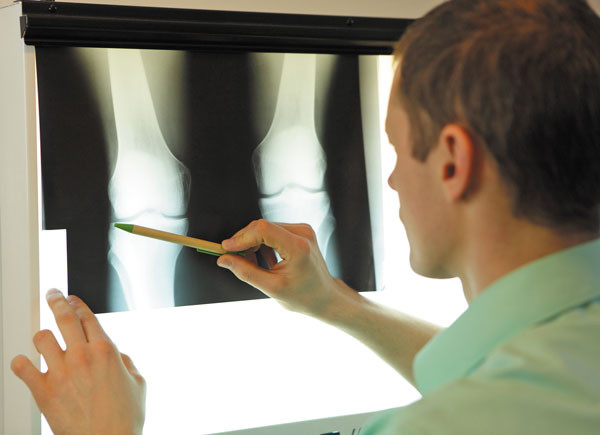
X-ray may be best screening tool for diagnosing knee pain
A simple x-ray may be a better and cheaper way to diagnose knee arthritis than an MRI, according to researchers. X-rays are also cheaper than MRIs and quicker to perform.
Reading the current blood pressure guidelines
Oat vs. dairy milk: Nutrition, benefits, and downsides
Microplastics: A hidden health threat?
Healing after food poisoning
What is tempeh? Benefits, nutrition, and how to use it
Light exposure at night may raise risk for heart disease
Whole grains may improve several heart risk factors at once
A lumbar belt may help ease low back pain
Children of centenarians may stay healthier and live longer too, study finds
Signs of pneumonia: Sometimes vague and unexpected
Free Healthbeat Signup
Get the latest in health news delivered to your inbox!
Sign Up
