










How does skin cancer differ in darker skin?
Ask the doctor
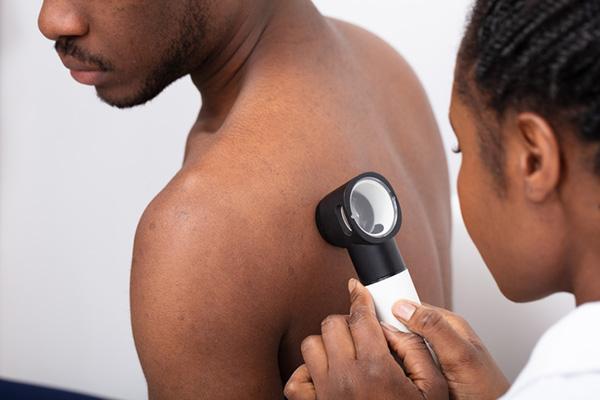
Q. My brother was recently diagnosed with skin cancer. Both he and I have very dark skin. Until now, I never worried about it. How big is the skin cancer difference compared to people with a fair complexion?
A. The skin cells in people with darker skin produce more melanin compared to lighter-skinned people. These cells, called melanocytes, are less susceptible to damage by the sun's rays.
Melanin helps absorb radiation from ultraviolet light, so darker skin with a greater concentration of melanin is much less likely to burn. But people with darker skin can still experience cellular changes that lead to skin cancer.
The types of skin cancers often associated with sun exposure happen less frequently in people with darker skin than in lighter-skinned people. But when skin cancers do occur in darker people, they can be harder to detect.
People with darker skin can “hide” worrisome changes, because they blend in or arise in less typical places on the body. This means these cancers are more likely to be diagnosed in later stages.
Squamous cell carcinomas
Sun exposure plays an important role in this type of skin cancer in light-skinned people. But in darker-skinned people, sun exposure appears to play less of a role. For example, most squamous cell carcinomas appear on the sun-exposed areas of the body of lighter-skinned people. But on darker-skin people, most squamous cell carcinomas tend to appear on skin and other surfaces not exposed to the sun, such as the palms of the hands and the soles of the feet.
Basal cell carcinomas
Because basal cell cancers happen primarily in sun-exposed parts of the body, the greater melanin concentration in darker people means they are much less likely to develop it. But similar to squamous cell cancers, they can occur on skin anywhere on the body. Basal cell cancers can continue to grow, but they rarely spread.
Melanoma
Melanoma refers to cancerous changes in melanocytes. In fair-skinned people multiple sunburns increase melanoma risk. But it can appear on any area of the body in lighter-skinned or darker-skinned people. In darker-skinned people, melanoma tends to be more commonly found on the inside lining of the mouth, under the nails, or on the palms of the hands or soles of the feet.
Check your moles
It is important to have strange-looking moles (or any mole that changes in any way) checked by your primary care clinician or a dermatologist.
Here is what you can look for:
- asymmetry (not symmetrical in shape, but lopsided)
- border changes (a jagged edge appears)
- color changes (a mole gets darker, changes color, or changes shades of color)
- diameter changes (a mole becomes as large or larger than a pencil eraser)
- evolving (a mole that begins changing in size, shape, color, or elevation)
Also watch for any skin spots or sores that do not heal. Have these checked as well.
Image: © AndreyPopov/Getty Images
Disclaimer:
As a service to our readers, Harvard Health Publishing provides access to our library of archived content. Please note the date of last review or update on all articles.
No content on this site, regardless of date, should ever be used as a substitute for direct medical advice from your doctor or other qualified clinician.


