Continuous glucose monitors benefit people who don't need insulin
News briefs
- Reviewed by Robert H. Shmerling, MD, Senior Faculty Editor, Harvard Health Publishing; Editorial Advisory Board Member, Harvard Health Publishing
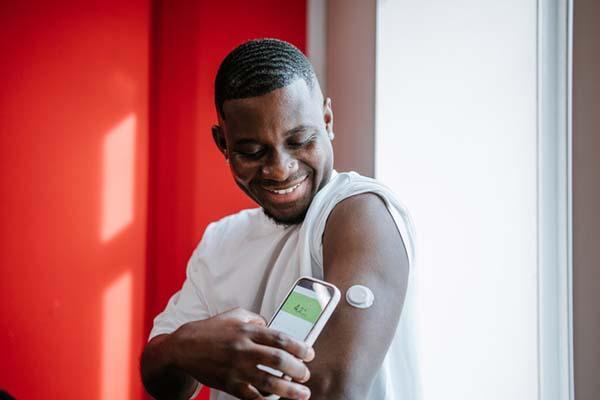
Continuous glucose monitors (CGMs) — small, wearable devices that continuously estimate a person’s blood sugar level — are known to help people who require insulin to better control their diabetes. A new study finds that CGMs offer similar benefits in people with diabetes who don’t use insulin.
Published Oct. 14, 2026, in the New England Journal of Medicine, the study included 283 adults with type 2 diabetes; none were using insulin but most were taking other diabetes medications. They were randomly assigned to either receive CGMs or routine care and followed for six months. About the size of two stacked quarters, CGMs are worn on the arm or belly. A tiny sensor measures the sugar level in the fluid just under the skin (which closely mirrors blood sugar) and wirelessly transmits the results to a smartphone or other device.
People who used CGMs experienced greater improvements in their A1c values, which reflect average blood sugar values over a three-month period and are an important indicator of how well a person is controlling their diabetes. On average, A1c levels dropped from 8.8% to 7.2% in those using CGM, compared to an average drop of 8.7% to 8.0% in the routine care group. Those in the CGM group also spent about five additional hours per day in their target glucose range compared with those receiving usual care.
CGMs offer real-time feedback that enables people to quickly see how their meals, physical activity, medications, and other behaviors affect their blood sugar levels, which may explain the study benefits. The 2026 guidelines from the American Diabetes Association already recommend CGMs for people with type 2 diabetes who don’t use insulin. The new findings provide strong support for that advice and could lead more health insurers to expand coverage of CGMs to include this group. Of the estimated 27 million adults in the United States diagnosed with type 2 diabetes, about 20 million do not use insulin.
Image: © Tatiana Meteleva/Getty Images
About the Author

Julie Corliss, Executive Editor, Harvard Heart Letter
About the Reviewer

Robert H. Shmerling, MD, Senior Faculty Editor, Harvard Health Publishing; Editorial Advisory Board Member, Harvard Health Publishing
Disclaimer:
As a service to our readers, Harvard Health Publishing provides access to our library of archived content. Please note the date of last review or update on all articles.
No content on this site, regardless of date, should ever be used as a substitute for direct medical advice from your doctor or other qualified clinician.