










Overeating? Mindfulness exercises may help
- Reviewed by Howard E. LeWine, MD, Chief Medical Editor, Harvard Health Publishing; Editorial Advisory Board Member, Harvard Health Publishing
We all experience moments of indulgence that lead to overeating. If it happens once in a while, it's nothing to worry about. If it happens frequently, you may wonder if you have an overeating problem or "food addiction."
Before you worry, know that neither of those is considered an official medical diagnosis. In fact, the existence of food addiction is hotly debated.
Food addiction, if it existed, would be caused by a physiological process, and you would experience withdrawal symptoms if you didn't have certain foods. That's different than saying you love sugar and it's hard not to eat sweets.
If your thoughts about eating are interfering with your ability to function each day, seek professional help. Your primary care doctor is a good place to start.
Many people, however, overeat unconsciously and don't realize it until after they finish a meal. That's where mindfulness exercises can help you stick to reasonable portion sizes.
What is mindful eating?
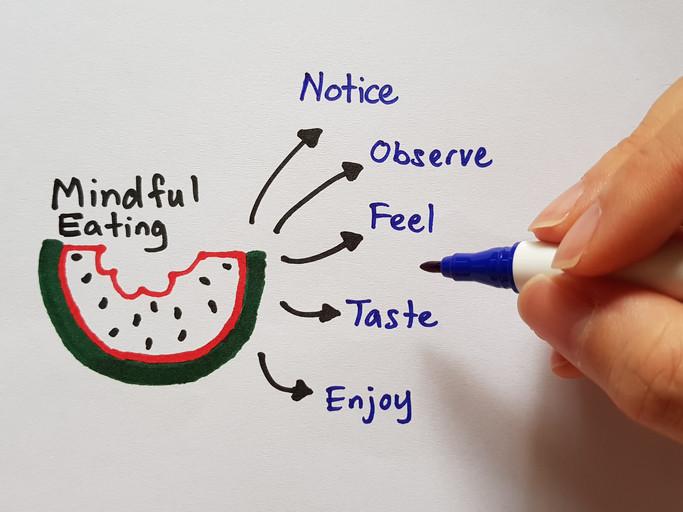
Mindfulness is the practice of being present in the moment, and observing the inputs flooding your senses. At meal time, think about how the food looks, how it tastes, and how it smells. What's the texture? What memories does it bring up? How does it make you feel?
By being mindful at meals, you'll slow the eating process, pay more attention to your body's hunger and fullness cues, and perhaps avoid overeating. Being mindful allows you to step back and make conscious decisions about what you're eating, rather than just going through the automatic process of transferring the food from your plate into your mouth.
Set yourself up for success in being mindful when you eat by:
- Removing distractions. Turn off phones, TVs, and computers. Eat in a peaceful, uncluttered space.
- Pacing yourself for a 20-minute meal. Chew your food slowly and put your fork down between bites.
More mindfulness exercises to try
Practicing mindfulness when you're not eating sharpens your mindfulness "muscles." Here are exercises to do that.
- Focused breathing. Breathe in and breathe out slowly. With each in breath, allow your belly to expand. With each out breath, allow your belly to go in. This promotes relaxation.
- Progressive muscle relaxation. In this exercise, you tighten and release one major muscle group at a time for 20 seconds. As you release a contraction, notice how it feels for the muscles to relax.
- Take a mindful walk, even if it's just for five minutes. Use your senses to take in your surroundings. What colors are the leaves on trees? Is there a smell of freshly cut grass in the air? Do you feel a breeze on your skin?
- Practice yoga or tai chi. Both of these practices include deep breathing and a focus on body sensations.
- Keep a journal. Write down the details of your day. Try to include a variety of sensations - the sights, sounds, and smells you experienced, and the textures you touched.
Don't worry about trying to be mindful all day long. Start with a moment here and there and build gradually. The more mindful you become throughout your day, the more mindful you'll become when you eat. And you may find that you're better able to make decisions about the food you consume.
About the Author

Heidi Godman, Managing Director
About the Reviewer

Howard E. LeWine, MD, Chief Medical Editor, Harvard Health Publishing; Editorial Advisory Board Member, Harvard Health Publishing
Disclaimer:
As a service to our readers, Harvard Health Publishing provides access to our library of archived content. Please note the date of last review or update on all articles.
No content on this site, regardless of date, should ever be used as a substitute for direct medical advice from your doctor or other qualified clinician.


