











Special Health Reports

Help for Your Sensitive Gut

sg0126-sensitive20gut20cov

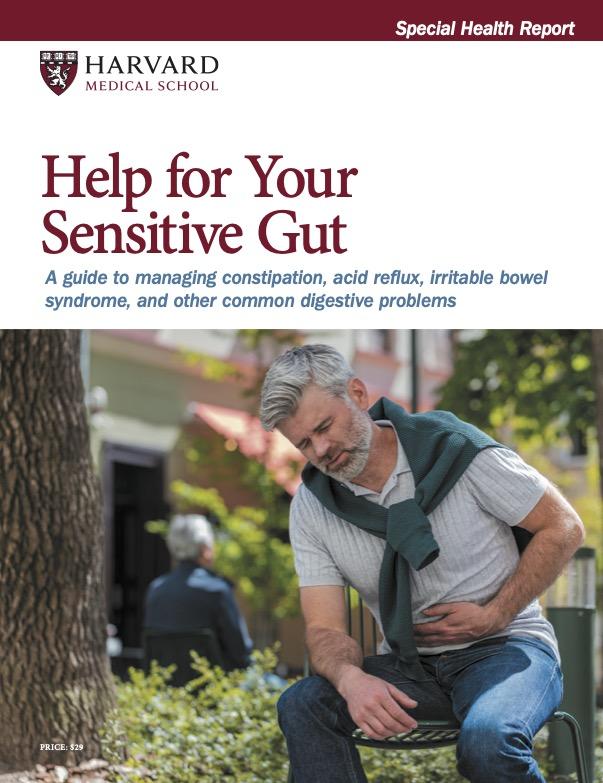
Help for Your Sensitive Gut: A guide to managing constipation, acid reflux, irritable bowel syndrome, and other common digestive problems

When your digestive system is running smoothly, you tend not to think about it. Once trouble begins, your gut — like a squeaky wheel — suddenly demands your attention. This Special Health Report, Help for Your Sensitive Gut, covers the major sources of gastrointestinal distress: irritable bowel syndrome, gastric reflux, upset stomach, constipation, diarrhea, and excess gas. It also includes a special Bonus Section describing how emotional stress and anxiety can cause gastrointestinal distress.

Other Product Information

Your “gut” is the series of organs — mouth, esophagus, stomach, small intestine, and colon — that transform the food you eat into the nutrients your body needs to live and to thrive. If you’ve ever had an upset stomach, constipation, heartburn or gas, you know how sensitive the gut can be. These “gut reactions” can be painful, disruptive, and sometimes embarrassing.

Fortunately, you can do something about almost all gastrointestinal disorders and achieve a calmer, quieter coexistence with your digestive system. You can address, prevent, and treat the most common troublemakers, including acid reflux, functional dyspepsia, irritable bowel syndrome, constipation, diarrhea, and excessive gas.

This report gives you strategies to prevent and treat heartburn, which is the key symptom of gastroesophageal reflux disease (GERD) and the most common gastrointestinal malady.  You’ll discover which pain relievers — from Prilosec and Nexium to Zantac and Tums — are the safest and fastest-acting remedies. You’ll be alerted to six diseases that can mimic the symptoms of irritable bowel syndrome (IBS), be briefed on new diagnostic tests and find ways to eliminate the triggers and manage this vexing condition.

In Help for Your Sensitive Gut, you will gain an empowering understanding of your digestive system, how it works, and what you can do when it acts up. The report explains the brain-gut connection and the effect stress can have on your digestive system. It shares the best ways to treat constipation without laxatives, tells you how simple mealtime changes can spare you from indigestion without forgoing the foods you love, and much more.

Prepared by the editors of the Harvard Health Publishing in consultation with Lawrence S. Friedman, M.D., Professor of Medicine, Harvard Medical School; Chair, Department of Medicine, Newton-Wellesley Hospital; Assistant Chief of Medicine, Massachusetts General Hospital. 48 pages. (2026)

Diagnosing reflux and GERD

Many people can manage heartburn through dietary changes and over-the-counter medications (see “Self-help for reflux”). But if your symptoms don’t respond to self-help techniques and interfere with sleep or daily life, see your doctor. If you have typical reflux symptoms that are mild and relatively infrequent—meaning less than two times a week—your doctor will usually skip diagnostic tests and recommend treatment (see “Medications,” page 6). If medications don’t help, they may order diagnostic testing. Your doctor will also be alert for other symptoms—such as frequent non-burning chest pain, bleeding into the gastrointestinal tract, dysphagia (difficulty in swallowing), hoarseness, or constant coughing and wheezing, which are typically associated with other problems, but may accompany GERD. When asthma strikes adult nonsmokers with no history of lung disease allergies, pH-monitoring studies sometimes suggest that GERD is a contributing factor. Experts now divide heartburn into four subtypes, depending on test results. Identifying the correct one helps ensure appropriate treatment:

  • Erosive esophagitis. The lining of the esophagus is already inflamed and worn away in spots as a result of acid exposure (see “Esophagitis,” page 9).
  • Non-erosive reflux disease. There is an abnormal amount of acid reflux, but no inflammation seen in the lining of the esophagus.
  • Reflux hypersensitivity. Acid induces heartburn symptoms, but the amount of acid that is refluxed is normal.
  • Functional heartburn. Heartburn occurs despite an absence of excessive acid reflux or increased sensitivity to acid (see “Do you have functional heartburn?” on page 5).
  • Heartburn and gastroesophageal reflux disease                                 
    • What causes reflux?.
    • Diagnosing reflux and GERD

    • Self-help for reflux

    • Medications

    • Surgical options for GERD

    • Complications of reflux

  • Chronic indigestion (dyspepsia)
    • What causes dyspepsia?               
    • Evaluating dyspepsia              
    • Treating dyspepsia          
  • Irritable bowel syndrome
    • What is IBS?
    • Possible causes of IBS
    • Diagnosing IBS
    • Managing IBS

  • SPECIAL SECTION: The stress connection

  • Constipation                         
    • Causes of constipation                              
    • Diagnosing the cause of constipation                             
    • Treating constipation                               
  • Diarrhea
    • Diagnosing the cause of diarrhea                                                               
    • Treating diarrhea                                  
    • Preventing diarrhea                                
  • Excessive gas
    • Where does gas come from?                           
    • A gas primer                                      
    • Diagnosing air swallowing and flatus                     
    • Treating belching and air swallowing
    • Treating flatulence
  • Abdominal pain disorders
  • Appendix: Medications for gastrointestinal disorders

Reviews

No reviews have been left for this newsletter. Log in and leave a review of your own.

You might also be interested in…

A Guide to Healthy Eating: Strategies, tips, and recipes to help you make better food choices

Eat real food. That’s the essence of today’s nutrition message. Our knowledge of nutrition has come full circle, back to eating food that is as close as possible to the way nature made it. Based on a solid foundation of current nutrition science, Harvard’s Special Health Report A Guide to Healthy Eating: Strategies, tips, and recipes to help you make better food choices​ describes how to eat for optimum health.

Read More

Free Healthbeat Signup

Get the latest in health news delivered to your inbox!

Sign Up