

Even a little exercise linked with lower stroke risk in people with afib

Testosterone therapy without evidence of deficiency may boost heart risk

Weight-loss drug may lower risk of heart attacks and infections

What to eat on the DASH diet

Migraine: How it's diagnosed and what that means

Tricep workouts you can do at home

Mindfulness practices to reduce stress and improve focus

Antihistamines may not offer meaningful relief from eczema symptoms

Overweight and taking blood pressure medications: Study finds it's a trend that's working

FDA approves first mRNA-based flu vaccine
Mind & Mood Archive
Articles

Why you should thank your aging brain
At middle age, the brain begins to draw on more of its capacity for improved judgment and decision making.
If you forget a name or two, take longer to finish the crossword, or find it hard to manage two tasks at once, you're not on the road to dementia. What you're experiencing is your brain changing the way it works as you get older. And in many ways it's actually working better. Studies have shown that older people have better judgment, are better at making rational decisions, and are better able to screen out negativity than their juniors are.
Although it may take you a little longer to get to the solution, you're probably better at inductive and spatial reasoning at middle age than you were in your youth. |

Common drugs linked to dementia
Medications called anticholinergics are used to treat a host of conditions—overactive bladder, depression, allergies, and Parkinson's disease. They usually aren't recommended for older adults because one of the most common side effects is confusion and difficulty reasoning. Early studies have also indicated that long-term anticholinergic use is associated with an increased risk of dementia, and a recent study by researchers at the University of Washington adds more evidence to support that connection. The results were published online Jan. 26, 2015, by JAMA Internal Medicine.
The researchers tracked almost 3,500 men and women ages 65 and older who were free of dementia. When they matched prescription data for the previous 10 years with the participants' health outcomes, they determined that using anticholinergics was associated with an increased risk of developing dementia. Moreover, dementia risk increased with the dosage of the drugs and the length of time they were used. While people who had taken these drugs daily for the equivalent of three months had no increase in risk, those who had used them for over three years had a 54% greater risk than nonusers.

When are opioids safe to take?
Opioids are commonly used to control acute, intense pain. Meditation, yoga, and acupuncture may help control pain when tapering off opioids. |
Although these powerful pain relievers can be addictive, opioids are safe for most people when used properly.

Edible marijuana — a half-baked idea?
Marijuana-laced brownies have long been a way to get high. Now a new generation of “food companies” is taking the concept of edible marijuana in a somewhat scary new direction: marijuana-laced foods that mimic popular candies. These sweets could pose a danger to children, warns a Perspective article in today’s New England Journal of Medicine. From a marketing perspective, it’s a cute concept to sell Buddahfingers that look like Butterfingers, Rasta Reese’s that mimic Reese’s Peanut Butter Cups, or Pot Tarts that resemble Pop-Tarts. But the availability of edible marijuana products has led to an increase in emergency visits to hospitals because of kids accidentally eating edible marijuana products and in marijuana-related calls to poison and drug hotlines.

The problem with plaque: Even lesser amounts are still risky
Known as non-obstructive coronary artery disease, this condition can trigger heart attacks down the road.
You just had a cardiac stress test and you passed with flying colors. Does that mean you are free of heart attack risk? Not necessarily, says Dr. Ron Blankstein, assistant professor of medicine at Harvard Medical School and preventive cardiologist at Brigham and Women's Hospital.

Can deep, slow breathing lower blood pressure?
Long, slow breaths may help dampen nerve activity that governs your blood pressure. Image: Thinkstock |
A device called RESPeRATE may help, but questions remain.

iPad can disrupt sleep, study suggests
Image: Thinkstock |
Using an iPad or other backlit electronic tablet in the hours before bedtime not only prevents you from falling asleep, it may also affect your alertness the next day, according to a report published in the Proceedings of the National Academy of Sciences, Dec. 22, 2014. Researchers at Harvard-affiliated Brigham and Women's Hospital found that the light emitted by the devices reset the body's circadian clock, which synchronizes the daily rhythm of sleep to daylight. As a result, people reading e-books took longer to fall asleep and were less alert the next morning than when they read print books instead.
During the two-week study, 12 men and women read digital books on an iPad for four hours before bedtime each night for five consecutive nights. They also followed the same routine using printed books. When they read the iPad, participants were less sleepy before bedtime but were less alert the following morning, even after eight hours of sleep.
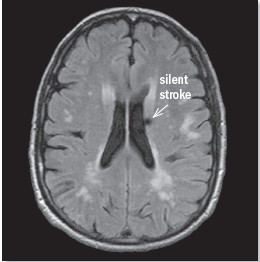
Reduce your risk of silent strokes
As seen on this MRI scan, a silent stroke |
Exercise, eat a healthy diet, and manage blood pressure and cholesterol to lower your odds.

Gentler exercise for mind and body is best for sleep
Image: Thinkstock |
Just as regular exercise has a host of health benefits for the body, staying mentally active appears to preserve memory and general sharpness. But for getting a good night's sleep, light workouts for both body and brain may be best, according to a study in the Journal of the American Geriatrics Society.
The study focused on 72 people, ages 67 to 79, who reported poor sleep as well as declining mental sharpness. They were assigned at random to do either strenuous aerobic exercise or a gentler stretching routine, paired with either watching educational DVDs (followed by short quizzes) or engaging in more demanding computer-based brain training.

Music can boost memory and mood
Dan Cohen watches Mary Lou Thompson, who has Alzheimer's, respond to the playlist he made for her. Image: Photo Courtesy of BOND 360 |
By Dr. Anne Fabiny, Editor in Chief, Harvard Women's Health Watch
Even a little exercise linked with lower stroke risk in people with afib
Testosterone therapy without evidence of deficiency may boost heart risk
Weight-loss drug may lower risk of heart attacks and infections
What to eat on the DASH diet
Migraine: How it's diagnosed and what that means
Tricep workouts you can do at home
Mindfulness practices to reduce stress and improve focus
Antihistamines may not offer meaningful relief from eczema symptoms
Overweight and taking blood pressure medications: Study finds it's a trend that's working
FDA approves first mRNA-based flu vaccine
Free Healthbeat Signup
Get the latest in health news delivered to your inbox!
Sign Up
