










The third-space benefits of exercise
Leaving your home to get fit with others amplifies the health benefits.
- Reviewed by Stephanie Collier, MD, MPH, Contributor; Editorial Advisory Board Member, Harvard Health Publishing
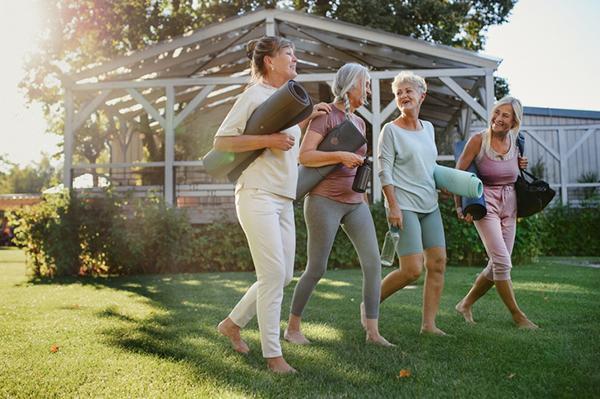
If you’ve ever returned home from a yoga class, a walk with neighbors, or a friendly pickleball game with some extra pep in your step, you’ve experienced firsthand the mood-boosting benefits of group exercise. What you might not realize is that by gathering with others to move and sweat, you’ve unknowingly tapped into the power of the “third space.”
What are third spaces?
Sociologists use the term “third space” (or sometimes “third place”) to describe places outside the home (first space) and work (second space) where people gather informally and connect. Third spaces such as cafes, bars, libraries, and religious institutions have long helped foster a sense of community. (Starbucks owes much of its success to positioning itself as a third space.) Research links time spent in third spaces with lower stress levels, improved mood, reduced feelings of loneliness and isolation, and a stronger sense of purpose.
But in a post-COVID world where remote work, online shopping, and food delivery are more common, “many people are missing out on the benefits of meeting others in community spaces and enjoying that social connection,” says Dr. Stephanie Collier, a psychiatrist at Harvard-affiliated McLean Hospital. Too much time spent at home can lead to an increased sense of isolation and loneliness, both of which can have significant mental and physical health consequences, including increased risks for heart disease and dementia. Retirees and partner caregivers are similarly at risk.
Here is where exercise as a third space comes in.
Boosting the health benefits of exercise
When you walk, run, swim, cycle, dance, or work out with others, you double up on the mental, social, and cognitive benefits of exercise.
For example, heart-pumping exercise increases nourishing blood flow to the brain, which is crucial for learning and memory. Exercising in the company of others multiplies the brain benefits. First, the very nature of working out in a third space, surrounded by others, means less isolation. Second, any talking that takes place (whether you’re chatting while walking, or communicating during a tennis game) stimulates the language-processing regions of the brain. And if you and your water aerobics classmates or squash buddies meet up later for coffee or lunch, you’ll enjoy even more cognitive stimulation and protection. (Friendships are good for your brain.)
There’s an accountability factor at play, too. “If you have plans to meet a friend at a yoga class twice a week, you’re far more likely to follow through,” Dr. Collier says. “Accountability adds structure and motivation. If your friend is expecting you, it turns intention into action.”
Third spaces are also thought to foster a sense of belonging — a “we’re all in this together” mentality that may help protect mental and physical health.
What counts as an exercise third space?
Gyms, group fitness classes, the local Pilates studio, a neighborhood walking group, an outdoor tai chi meet-up — almost anything goes. So long as you’re leaving your home and exercising with at least one other person, you’re enjoying the third-space perks of fitness. “Walking with even just one companion is associated with less loneliness,” Dr. Collier says. “It’s more about quality, not numbers.”
While any physical activity provides benefits, moderate-intensity workouts optimize the heart and brain benefits associated with physical activity. Dr. Collier encourages her patients to aim for a brisk pace that makes conversation challenging, but not impossible. When choosing an exercise partner, she suggests, “Ask yourself, ‘Who can match my pace?’”
For even more third-space benefits, head outside. Studies show that exercising in nature (a group forest hike, power-walking around a lake with a friend) feels easier than exercising indoors, so people tend to work out longer and harder.
Third-space fitness ideasWhen it comes to exercise, the third space is the charm. Where can you find one that’s right for you? You might check out local community or senior centers for free or low-cost fitness classes. Other options include
|
Image: © Halfpoint Images/Getty Images
About the Author

Leslie Goldman, MPH, Health Writer
About the Reviewer

Stephanie Collier, MD, MPH, Contributor; Editorial Advisory Board Member, Harvard Health Publishing
Disclaimer:
As a service to our readers, Harvard Health Publishing provides access to our library of archived content. Please note the date of last review or update on all articles.
No content on this site, regardless of date, should ever be used as a substitute for direct medical advice from your doctor or other qualified clinician.


