










The best stretching routines for men
Although men may be somewhat less flexible than women, stretching offers important benefits to everyone.
- Reviewed by Daniel Orr, PT, DPT, OCS, CSCS, Contributor

An old New Yorker cartoon shows a woman speaking to a man while they’re both in a downward dog yoga pose. The caption — “You do yoga like a guy” — alludes to the popular perception that men aren’t as flexible as women. But is that really true? And do recommendations for stretching apply to both men and women?
In fact, there’s scant research on the topic, although one small study found that young men’s calf and hamstring muscles (the three large muscles at the back of each thigh) were stiffer than those of young women. However, a three-month stretching program improved flexibility equally well in both sexes.
“Compared to women, men may be less likely to engage in yoga or other pursuits that incorporate flexibility exercises, such as dance or Pilates,” says Daniel Orr, a physical therapist at Harvard-affiliated Spaulding Rehabilitation Hospital. Still, it’s not unusual for both men and women to skip stretching. “When you have only 30 minutes for a workout, you may be tempted to spend more time doing more energetic activity that boosts your endorphin levels,” he says.
But a regular stretching routine has many benefits for everyone — especially as you age. It can keep your muscles limber, extend your range of motion, and improve your posture and balance. If you play sports, tight muscles can contribute to muscle strains and knee pain, and may even hinder your performance if your muscles aren’t able to fully extend.
Stretching suggestions
The American College of Sports Medicine suggests that healthy adults try to stretch all the major muscle-tendon groups — neck, shoulders, chest, trunk, lower back, hips, legs, and ankles — at least twice a week. “Doing a few stretches every day may be even better for staying flexible,” says Orr. Try adding short stints of stretching to different parts of your day. For example, try varied stretches to break up long periods of sitting, in addition to stretching before, during, or after your regular exercise routine.
Although the standard advice is to hold a stretch for at least 30 seconds, Orr finds that a longer hold — at least one minute — can help you get a deeper stretch and reap greater benefits.
Daily stretch breaks
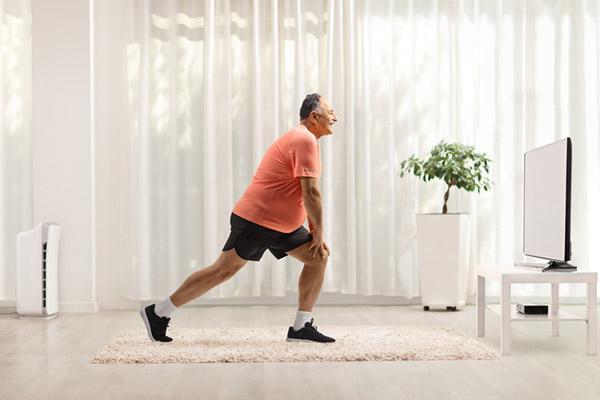
People often sit at a computer for long periods, which can tighten muscles in their hamstrings and hip flexors (the muscles at the top front of the thigh, near the pelvis). Try taking a short break to do some standing hip flexor stretches (see photo), which can help keep those muscles supple.
Another simple stretch involves lying on your back with a rolled-up towel placed vertically under your back, supporting your spine from your tailbone to your head. Bend your knees, keeping your feet flat on the floor. Open your arms into a T shape, palms facing up, which will release the muscles in your chest. This helps counteract the common habit of hunching the shoulders slightly forward.
Standing hip flexor stretch
Start standing. To stretch your right side, place your left foot flat on the floor in front of you, bending the left knee slightly. Extend your right leg behind you. Place your hands on your left thigh (or a counter for support, if needed). Lean forward toward your left foot until you feel a stretch in the front of your right upper thigh and hip. Hold for 60 seconds. Return to standing, then repeat with your right leg forward. Tips and techniques:
Image: © Ljupco/Getty Images |
Dynamic stretches
Before exercising, do a few minutes of dynamic stretching, which gently limbers up your muscles and loosens your joints. Mimic the activity you’re about to do, but at a lower intensity, such as marching in place before a jog. Arm swings or circles make sense before swimming, golf, or racquet sports. Pay attention to posture and good form, and remember to breathe, says Orr.
Static stretches
Ideally, you should do static stretching (in which you adopt and hold a position) after you exercise, when your muscles are warm and stretch more easily. But you might also add static stretches between sets of a strength training workout. “If you’re doing an upper-body exercise, such as a seated overhead press, you can stretch your hamstrings while you recover between sets,” says Orr. Extend one leg straight in front of you, heel grounded on the floor and toes pointed toward the ceiling. Hinge forward from your hip, hands on the thigh of your opposite leg. For more information and many more stretching exercises, read Stretching, a Special Health Report from Harvard Health Publishing.
Image: © Kobus Louw/Getty Images
About the Author

Julie Corliss, Executive Editor, Harvard Heart Letter
About the Reviewer

Daniel Orr, PT, DPT, OCS, CSCS, Contributor
Disclaimer:
As a service to our readers, Harvard Health Publishing provides access to our library of archived content. Please note the date of last review or update on all articles.
No content on this site, regardless of date, should ever be used as a substitute for direct medical advice from your doctor or other qualified clinician.


