










Special Health Reports

Positive Psychology

$20.00
$18.00
$29.00
positivepsychologypp25cover

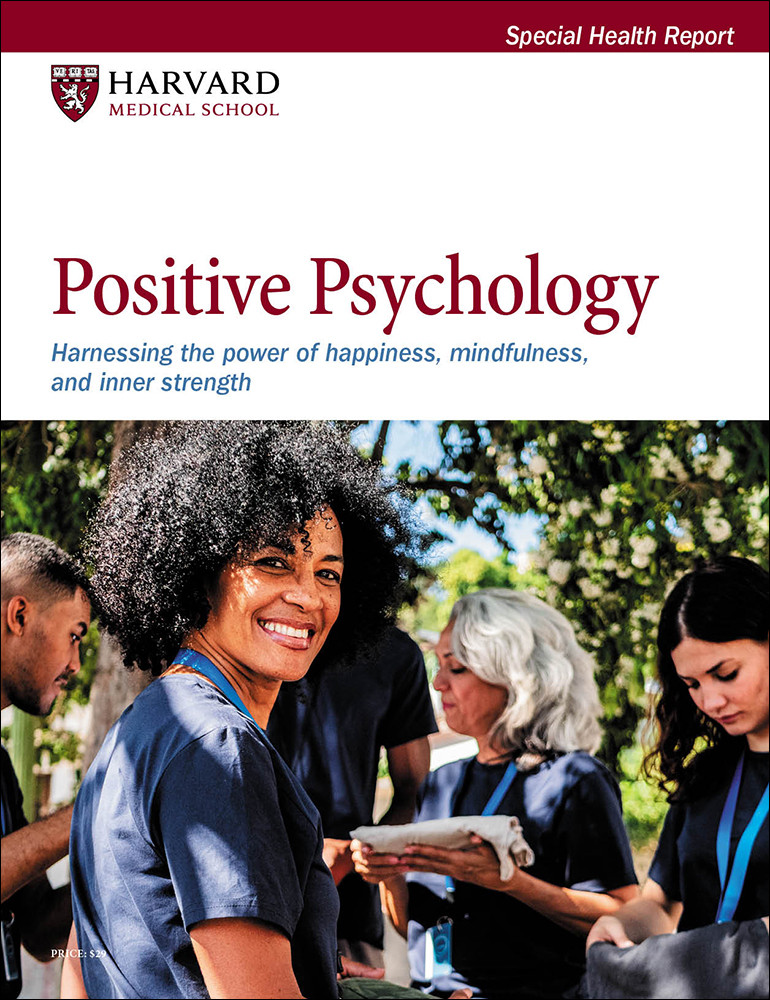
Positive Psychology: Harnessing the power of happiness, mindfulness, and inner strength

Positive emotions have been linked with better health, longer life, and greater well-being in numerous scientific studies. On the other hand, chronic anger, worry, and hostility increase the risk of developing heart disease, as people react to these feelings with raised blood pressure and stiffening of blood vessels. But it isn’t easy to maintain a healthy, positive emotional state. Positive Psychology: Harnessing the power of happiness, mindfulness, and inner strength is a guide to the concepts that can help you find well-being and happiness, based on the latest research.

Other Product Information

Positive emotions have been linked with better health, longer life, and greater well-being in numerous scientific studies. On the other hand, chronic anger, worry, and hostility increase the risk of developing heart disease, as people react to these feelings with raised blood pressure and stiffening of blood vessels. But it isn’t easy to maintain a healthy, positive emotional state. People often misjudge what will make them happy and content. Positive Psychology: Harnessing the power of happiness, mindfulness, and inner strength is a guide to the concepts that can help you find well-being and happiness, based on the latest research. This report includes self-assessment tests and step-by-step advice and exercises to help you maximize the positive emotion in your life.

This report was prepared by the editors of Harvard Health Publishing in consultation with Ronald D. Siegel, Psy.D. Assistant Professor of Psychology, Part-Time, Harvard Medical School and Cambridge Health Alliance. 49 pages. (2026)

Can mindfulness change your brain?

Mindfulness meditation—specific practices designed to cultivate mindfulness—can actually change your brain in ways that correlate with reduced stress and a better mood. It does this in complex ways that ongoing research is attempting to clarify.

In one early set of studies, brain imaging was used to identify a link between mindfulness practice and positive emotion in the brain. The researchers found that the right prefrontal cortex was active in people who were anxious, depressed, or hypervigilant (scanning their environment for danger), while the left prefrontal cortex was more active in people who had fewer negative moods. After gathering data on the brains of hundreds of people, it was observed that the person with the most dramatic left-side activity was a Tibetan monk with extensive experience practicing mindfulness meditation.

Further studies showed that not only did other monks share this characteristic, but a shift from right-sided to left-sided activation also occurred in other groups of people—such as stressed-out high-tech office workers—after they had been trained to do mindfulness meditation. The trained workers also reported improved mood and more engagement in their activities. They even had stronger immune system responses compared with workers who had not learned mindfulness meditation.

The first study to show changes in brain structure associated with mindfulness practice compared 20 individuals with extensive experience in mindfulness practice to peers who didn’t have any. This research found thickening of brain regions associated with attention, sensory processing, and interoception (noticing what’s happening in your body). But it’s hard to know with certainty from such a study if it was actually the mindfulness practice, rather than some other difference between the groups, that accounted for the difference in their brains.

Later studies have tried to address this problem by looking at people’s brains before and after meditation training, comparing their brains with those of people who did not receive the training. Many such studies have shown changes in various brain regions—with more pronounced changes occurring in people who were more distressed at the outset of the study. However, the changes tend not to last if participants don’t continue practicing. Studies also show improved learning and memory in healthy older adults who practice mindfulness meditation.

  • What is happiness
    • The hedonic treadmill
    • The pursuit of sustainable happiness
    • Pleasure circuitry in the brain
  • How happy are you?
    • Happiness and your genes
  • Pathways to happiness
  • Building on strengths of character
    • Finding your strengths
    • Using your strengths
  • Gratitude
    • Counting your blessings
  • Savoring pleasure
    • Pleasure and choice
  • Flow: Getting engaged and absorbed
    • Matching your skill level
    • Flowing through the workday
  • Special bonus section: Mindfulness: A path to well-being
  • Nurturing your relationships
    • Connect with friends
    • Enhance a romantic relationship
    • Forgive someone
  • Make a connection, not an impression
    • Press pause on social media
  • Self-compassion
    • Learn to have self-compassion
  • Finding your life’s meaning
    • Spirituality and happiness
    • Practice random acts of kindness
  • Positive psychology during difficult times
  • Finding help in becoming happier
    • Licensed mental health professionals
    • Life coaches
  • Resources
  • Glossary

Reviews

No reviews have been left for this newsletter. Log in and leave a review of your own.

You might also be interested in…

Stress Management: Enhance your well-being by reducing stress and building resilience

While some stress is inevitable, when your body repeatedly encounters a set of physiological changes dubbed the stress response, trouble can brew. Stress may contribute to or exacerbate various health problems. But it’s possible to dismantle negative stress cycles. This Special Health Report, Stress Management: Enhance your well-being by reducing stress and building resilience, can help you identify your stress warning signs and learn how to better manage stressful situations.

Read More

Free Healthbeat Signup

Get the latest in health news delivered to your inbox!

Sign Up