Knees and Hips: A troubleshooting guide to knee and hip pain

Knees and Hips: A troubleshooting guide to knee and hip pain
Take charge of your joint health with expert guidance from Harvard!
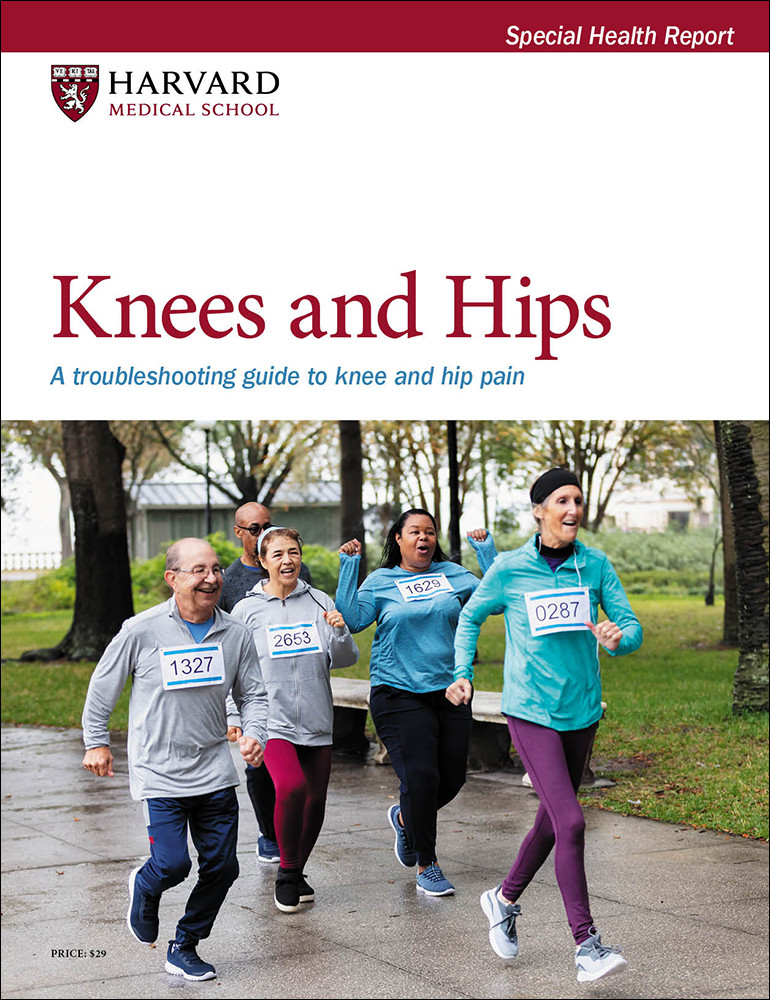
Find strategies to tackle painful knee and hip problems.
Whether you’ve been battling knee or hip pain for years, or are feeling the first twinges of pain today, Knees and Hips — a Special Health Report from Harvard Medical School — will show you the research-backed ways to ease pain so you can work towards staying active and independent for years to come.
This Special Health Report covers common problems that could be causing your pain, such as osteoarthritis, tendinopathy, bursitis, a muscle strain, a ruptured tendon, a torn meniscus, a labral tear, a broken hip, and more.
You’ll find out how your knees and hips are constructed and learn about common injuries that can affect each joint — and the different types of pain they cause. You’ll see how familiarizing yourself with the various parts of your knees and hips will help you understand how injuries can happen and what treatments you might want to discuss with your doctor.
Inside Knees and Hips, You'll Uncover:
- Aerobic exercises that are easy on the joints but will still help keep you in shape
- Why one of the best things you can do for your knees is lose a few pounds if you’re overweight
- 6 signs that your knee pain may be caused by bursitis
- The types of exercises that can help improve joint function
- The over-the-counter drug that is well known for reducing inflammation
- Which healthy habits can help lower your risk of osteoarthritis of the hip
For more information like this, order your copy of Knees and Hips today!
Don’t miss out! There are only a limited number of reports available. Order your report today and you’ll save 30% off the regular $29 price — and get our full Money-Back Guarantee. Order now.
When your knees or hips pop or grind, it may seem like all that noise is a sign of a big problem. However, if there’s no pain or swelling, the noises are not usually a sign of trouble. The sound you hear may be a tendon moving across your joint. Or you may have momentarily (and harmlessly) broken the seal of synovial fluid that fills the joint capsule. However, if you hear a noise at the time of an injury, or you hear a grating sound, you should see your doctor.