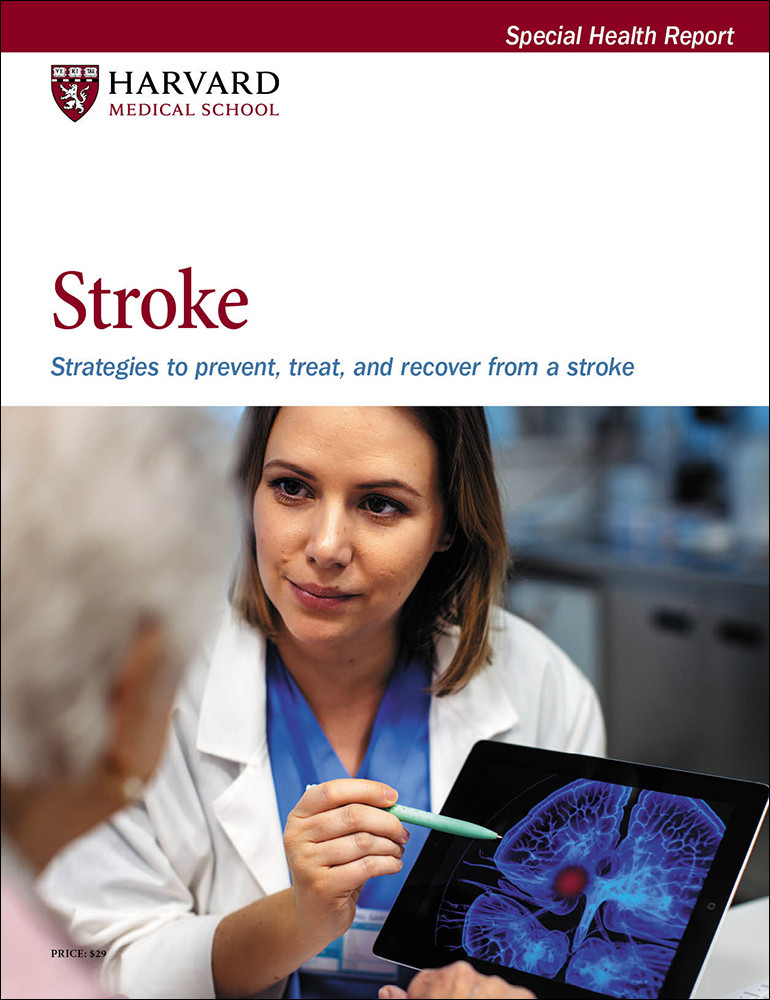
Stroke: Preventing and treating "brain attack"
There are many types of stroke, each cause different kinds of damage and require different treatments. But discovering the exact cause of a stroke is a complicated matter. This report describes each type and its diagnosis and treatment. It also includes a special section on preventing stroke and guidelines for rehabilitation and recovery.
Created by the editors of Harvard Health Publications in collaboration with J. Philip Kistler, M.D., Professor of Neurology, Harvard Medical School and Neurologist and Director Emeritus, Stroke Service, Massachusetts General Hospital. 48 pages. (2008)
- What is a stroke?
- Bleeding or blockage?
- Ministrokes (TIAs)
- Who is at risk for stroke?
- What to do if you’re having a stroke
- How the brain works
- A micro view of the brain
- A macro view of the brain
- When stroke (or TIA) strikes
- Know the risk factors
- Subtypes and causes of stroke
- Ischemic strokes and TIAs
- Hemorrhagic strokes
- Diagnosing a stroke
- Physical examination
- Laboratory tests
- Imaging and blood-flow studies
- Telecommunication and stroke (TeleStroke)
- Treating ischemic stroke
- Phase 1: Early, hyperacute phase
- Phase 2: Acute and subacute phase
- Phase 3: Prevention of secondary stroke
- Treating hemorrhagic (bleeding) stroke
- Coiling
- Surgery
- Medication
- Rehabilitation
- Assessing your needs
- Rehabilitation facilities and services
- Rehabilitation specialists
- What to expect
- Life after stroke
- The emotional impact of stroke
- Managing post-stroke pain
- Returning home
- Glossary
- Resources
Stroke has always been a much-feared disease. Mistakenly, it has been thought that little could be done to treat strokes or even prevent them. But treatment and prevention strategies do exist. When you or someone you know has a stroke, the first and most important step is a rapid, precise diagnosis. Such a diagnosis is based, in part, on the location and extent of the damage to the brain. Also important are the type and location of the blood vessel damage that caused the stroke, and the nature of any remaining blood flow around the ruptured or blocked blood vessel. When a blood vessel ruptures, it is called hemorrhagic (bleeding) stroke; when a vessel is blocked, it is called ischemic (low blood flow) stroke. Both can cause damage to areas of brain tissue.
Strokes can occur suddenly, producing major symptoms and signs. But often the symptoms and signs are mild, minor, or temporary, heralding a more devastating event to come, be it in minutes, hours, or days. It becomes extremely important for patients and families to be aware of the symptoms and signs of strokes or transient ischemic attacks (TIAs), if they are to get to the hospital as rapidly as possible. The longer an artery or arteries in the brain remain blocked, the less chance the brain has to recover. Hence the expression, “Time is brain!” For this reason, stroke is often referred to as “brain attack,” similar to “heart attack.”
It may surprise you to learn that someone in the United States has a stroke every 40 seconds, and someone dies of a stroke every three to four minutes, amounting to 780,000 strokes and 150,000 deaths annually. Stroke is the third leading cause of death in this country, behind heart disease and cancer.
Despite its prevalence, stroke is highly preventable. In this report, we hope you’ll learn how to assess your risk of stroke and reduce your likelihood of having one. Taking preventive steps is especially important for people who have already had a stroke, because having one stroke increases the odds of having another. The latest guidelines issued jointly by the American Heart Association (AHA) and the American Stroke Association (ASA) call for aggressive preventive measures. The new stroke guidelines also underscore the importance of controlling blood pressure, a step that can reduce stroke risk by 30% to 40%, as well as managing diabetes and cholesterol, exercising regularly, avoiding smoking, controlling weight, and drinking alcohol only in moderation.
The following reviews have been left for this report. Log in and leave a review of your own.